
Do AI Agents Actually Exist? A Builder’s 6-Level Framework
The skeptics are mostly right. Most of what’s being marketed as “AI agents” in 2026 is a workflow with a chat interface bolted on top. A Zapier flow with an LLM step inside it. A Make automation that asks a model to write a subject line before sending the email. These are useful tools. They are not agents.
Agents do exist. The word has just been applied so liberally that the category has lost its edges. The useful question is what level of autonomy does a given system actually have, and which level does your problem actually need.
This is a six-level spectrum from “human with AI assistance” to “cognitive agent.” Most systems sold as agents today live at levels 2 or 3. Level 6 barely exists yet. Knowing where a product actually sits on this spectrum is how buyers avoid paying Level 4 prices for Level 2 capability.

The Reddit Thread That Got This Right
On r/AI_Agents (a community of 250,000+ members), the same thread surfaces every few weeks: “Do AI agents actually exist, or are we just building fancy AI workflows and calling them ‘agents’?” The top comments always land in roughly the same place: if it doesn’t act independently, if it doesn’t coordinate with other systems, if it doesn’t make decisions, then it’s a workflow.
That community instinct is correct. A practitioner who writes on this exact topic, Tobias Zwingmann, put it plainly: “some companies (looking at you, Microsoft!) call anything that touches AI an ‘agent.'” When definitions get fuzzy, projects get overbuilt, underbuilt, or simply set up the wrong way.
Real AI agents exist. Most vendor products marketed as agents are not agents. The capability spectrum underneath the word is more useful than the word itself.
The Agent Reality Spectrum (6 Levels)
Being agentic means having agency: taking action, making decisions, pursuing goals. That is a spectrum, not a binary. We have published a five-level AI maturity framework focused on organizational adoption. This spectrum is different. It focuses on the AI system itself and how much agency it actually has.
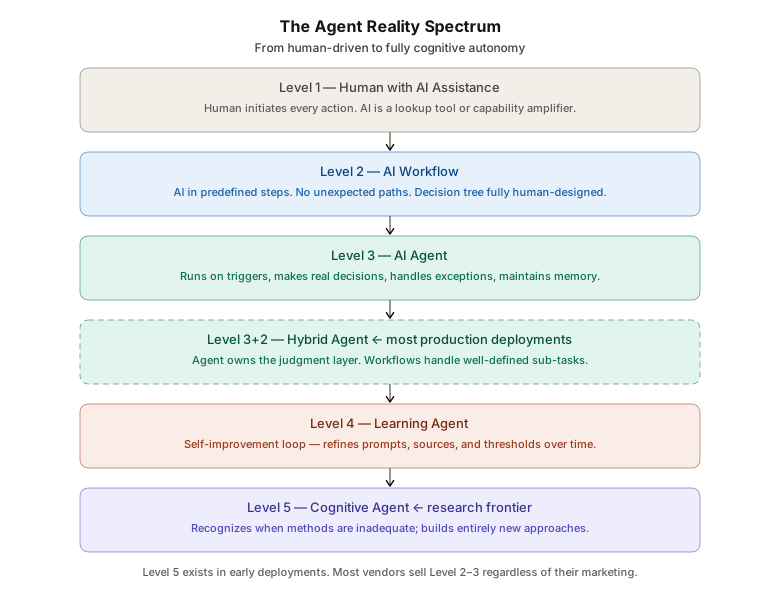
Level 1: Human with AI Assistance
A person sits at a browser, opens ChatGPT or Claude, asks a question, gets an answer, and uses it. The human is the agent. The AI is a tool, like a calculator with better language skills.
You have seen this when someone says “I used AI to write this” and they mean “I pasted my draft into a chat window and accepted the suggestions.” Completely legitimate, often valuable, not an agent by any stretch. Nothing takes action without the human pressing a button.
Level 2: AI Workflow
A workflow with an AI step inside it. A form submission triggers a Zapier run. The flow calls an LLM to classify the submission. The classification routes the record into HubSpot and sends a Slack message. The path is deterministic. The AI step is bounded, predictable, and replaceable.
You have seen this when someone says “my AI agent Bob processes my forms every day and emails me a summary.” Bob is a scheduled automation with an LLM step. Calling Bob an agent is fine as shorthand. Believing Bob is the same category of thing as an autonomous system would be a mistake.
This is where most products marketed as agents live. n8n flows, Make scenarios, Zapier automations with AI steps, GPT wrappers with webhooks. Genuine value, but not agency.
Level 3: AI Agent
An AI system that does work on behalf of a human when asked or when triggered by a clock or event. It selects its own tools, makes decisions along the way, handles reasonable exceptions, and produces a finished deliverable. A human initiated the job. The agent decided how to do it.
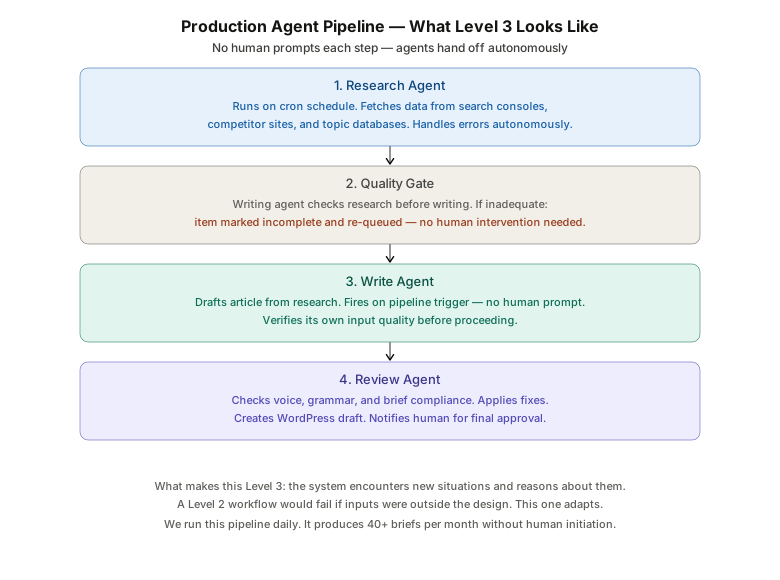
Concrete example: a research agent receives a topic, decides which keyword APIs and web sources to query, synthesizes the results, writes a structured brief, and escalates when it cannot confirm a fact. The human did not write a step-by-step script. The agent figured out the path.
Level 3 is the first level where the word “agent” earns its meaning. These systems have goals, tools, memory, and judgment within their scope.
Level 4: Hybrid Agent (Agents That Trigger Workflows)
A Level 3 agent that also initiates and orchestrates lower-level workflows. This is often the right architecture in production. The agent reasons about what needs to happen. Deterministic workflows handle the parts that must be reliable, auditable, and fast. The agent delegates predictable sub-tasks to workflows rather than reasoning through them from scratch every time.
In practice: a content agent decides a brief is ready for drafting. It triggers a publishing workflow that uploads the draft to WordPress, sets the correct taxonomy, generates image placeholders, and notifies a reviewer. The agent made the decision. The workflow made the deployment reliable. Neither layer is trying to do the other’s job.
Proper implementations of Level 3 almost always look like Level 4 once they hit production. Pure agents that reason through everything end to end tend to be slow, expensive, and harder to debug than the hybrid version.
Level 5: Learning Agent
A Level 3 or 4 agent with a self-improvement loop. The agent not only takes action, it also has a means to improve its own outcomes over time. It notices when a particular sub-workflow is producing weaker results, experiments with adjustments, measures the delta, and keeps the changes that help. The focus of the self-improvement is tuning existing workflows, not inventing new ones.
This is harder to build than it sounds. The agent needs persistent memory, a way to evaluate its own outputs, and enough guardrails that experimentation does not degrade production. Some of what vendors call “learning” at this level is actually just RAG, retrieving from a larger context window. Genuine Level 5 systems change their behavior over time in response to feedback loops they themselves manage.
Level 6: Cognitive Agent
Everything at Level 5, plus the ability to create entirely new workflows when the existing ones are not good enough. The agent reflects on what it is doing, decides its current approach is inadequate, and designs a different one. It identifies capabilities it does not have and requests them. It stops and restarts with a fundamentally different plan.
This is cognition in the meaningful sense: self-reflection on strategy, not just execution. Most of what exists at Level 6 today is experimental. We are actively building in this direction with a meta-agent architecture that coordinates other agents against portfolio-level objectives. The systems that genuinely operate here are rare, and anyone claiming their product is Level 6 today should be asked to show the reflection loops in the logs.
The Six Levels at a Glance
How each level behaves across the dimensions that matter for buying decisions:
| Level | Trigger | Decision-Making | Error Handling | Memory | Coordination | Output |
|---|---|---|---|---|---|---|
| L1 — Human + AI | Human types a prompt | Human decides | Human resolves | Session-only | None | Answers in chat |
| L2 — Workflow | Event or schedule | Predefined path | Stops and logs error | None or flow-state only | Integration-level | Data action (record, email) |
| L3 — Agent | Human or schedule | Chooses tools and path | Retries, reroutes, escalates | Task-scoped | Calls tools and APIs | Finished work product |
| L4 — Hybrid | Human, schedule, or other agent | Reasons, then delegates to workflows | Retries at both layers | Cross-session, persistent | Agent-to-agent, agent-to-workflow | Work product + downstream system changes |
| L5 — Learning | Continuous + triggers | Tunes its own behavior from feedback | Learns to avoid past failures | Long-term, structured | Orchestrates multiple agents | Improving work product over time |
| L6 — Cognitive | Goal-directed, self-initiated | Reflects, redesigns strategy | Rebuilds approach when stuck | Meta-memory about its own process | Creates new agent/workflow compositions | Novel solutions to previously unseen problems |
What Real Autonomy Looks Like in Production
Saying “we run agents” is cheap. The shape of the operational proof is what matters. Our content pipeline runs on a completion-triggered cron graph: research → write → review → dedup check → art direction → publish. Each stage hands off to the next without a human in the middle. A recovery cron sweeps every two hours and retries items that have gone stale. When a stage fails, the item is blocked with the exact reason and escalated, not silently dropped.
Anyone can stand up a single agent. The question is whether the system handles failure, maintains handoffs when no one is watching, and produces finished work product that downstream systems consume. You can read more about how that pipeline is structured in how our AI agent teams work in business operations, and the individual research layer is documented on the autonomous SEO research agent page.
If a vendor cannot show the equivalent (cron logs, error handling branches, recovery behavior when a step breaks, the artifact produced at each handoff), they are selling a Level 2 workflow with a Level 4 label. The proof is in the logs, not in the demo.
Seven Questions to Tell a Real Agent from a Workflow
Ask any vendor marketing an AI agent these seven questions. The answers reveal what level the product operates at.
- Does it run without being prompted each time? A real agent works on a schedule or a trigger. If the only way to use it is to type in a chat window, that is a chatbot, not an agent.
- Can it choose between different approaches based on context? Agents make decisions. Workflows follow paths. If the product always does the same thing in the same order, it is a workflow.
- Does it handle unexpected situations without failing? Real agents retry, skip, escalate, or reroute when something goes wrong. Workflows stop and log an error.
- Does it maintain memory across sessions? An agent that forgets everything between runs is not really working on a job. It is answering the same question over and over.
- Can it coordinate with other systems or agents? Real agent systems pass work between specialized agents. A single chatbot doing everything alone is probably Level 1 or 2.
- Does it produce work product, or just answers? Agents produce things: briefs, reports, code changes, draft posts, categorized leads. Conversations about what to produce are not the same as production.
- Can the vendor show it running? Ask for a screen recording of the system doing its job in production, not a demo environment. Ask for cron logs. Ask for error handling examples. If the answer is “we can set up a demo,” the system probably only works in a demo.
A Level 4 system answers yes to all seven. A Level 2 workflow marketed as an agent usually fails on questions 1, 3, and 7 immediately.
The Buyer-Education Gap Drives the Confusion
The confusion keeps getting worse for a structural reason: sellers are racing ahead while buyers have no shared reference point. In 2025, everything became “AI.” In 2026, everything became an “agent.” The label keeps shifting. The underlying capability has not changed nearly as fast as the marketing.
A buyer evaluating two offerings, one at $100 per month and another at $1,000 per month, has almost no way to tell them apart without already understanding the spectrum. Both call themselves agents. Both show a chat interface or a dashboard in the demo. Both list impressive-sounding capabilities. The $100 product is probably a Level 2 workflow. The $1,000 product might be a real Level 3 or 4 agent, or it might be a Level 2 product with better branding. Without a framework, the buyer picks based on price, relationship, or which demo looked prettier.
The seller knows the difference. The seller also knows the buyer often cannot tell. That asymmetry is the market dynamic right now, and honest sellers lose business to dishonest sellers whenever the buyer cannot distinguish between them.
The fix is not vendor trust. It is buyers doing the work to understand the spectrum before evaluating products. The seven-question checklist above is a starting point. Our business leader’s guide to AI agents covers the underlying mechanics in more depth. The AI agent development landscape covers who is actually shipping what.
External Signals That Agents Are Real Enough to Matter
Skepticism should not tip into dismissal. The industry has problems with definitional sloppiness, but it also has real adoption signals, and most of them describe a widening gap between strategic interest and production reality.
According to an IBM 2025 survey, 70% of executives say agentic AI is important to their business. According to CMI research, only 28% of B2B marketers are actually experimenting with it. That is a substantial gap between stated priority and hands-on adoption. And even among companies that have started, IT Pro reports that roughly half of agentic AI projects are still stuck at the pilot stage. The direction of travel is clear. The pace is slower than vendor decks suggest.
Security incidents are the other signal. According to a Gravitee report, 88% of organizations running agents have had agent security incidents. You do not have security incidents with things that do not exist. Agents are real enough to cause problems, which is proof they are real enough to be building for.
When Level 2 Is the Right Answer
Most business needs are best served by Level 1 or Level 2. If your problem is “this predictable process eats three hours a week and we want it off our plate,” you need a workflow. Maybe an AI step inside it. You do not need a Level 4 agent, and paying for one would be wasted.
Level 3 and above become worthwhile when the work itself requires judgment: choosing between strategies, adapting to variable inputs, coordinating across systems, handling exceptions, or producing output whose quality depends on context the system has to figure out on its own. If your work does not need those things, a Level 4 agent is expensive overkill. A Zapier flow will do fine and will be easier to debug when it breaks.
The starting question is not “do I need an AI agent” but “what is the job, what decisions does it require, and how much autonomy does the system need to do it well.” For a deeper look at how conversational AI compares to systems that actually take action, see our writeup on the AI progress gap between conversational and agentic AI.
Where This Is All Heading
The spectrum is not going away. As Level 5 and 6 systems mature, the gap between a workflow and an agent will widen, not shrink. That is good for buyers in the long run, because the capability differences will become too obvious to hide behind labels. In the short run, it means more confusion, more vendor creativity in rebranding Level 2 products as agents, and more buyers paying for autonomy they are not receiving.
The practical response is to match the level of autonomy to the problem, verify the vendor’s claims with the checklist above, and be willing to walk away from products that cannot show their work. Agents exist. They are useful. Most products that claim to be agents are not. Holding all three at once is what buying well in 2026 looks like.
FAQ
Are AI agents just chatbots?
No. Chatbots are reactive, responding to prompts and sitting idle when nobody is typing. Agents are proactive. They run on schedules or triggers, make decisions, and produce work product without a human initiating each step. Many vendors blur the line by calling chatbots “agents,” but the distinction matters when evaluating what you are actually buying.
What is the difference between an AI agent and agentic AI?
An AI agent is a specific system that acts autonomously within its scope. Agentic AI is the broader category: the architecture, patterns, and capabilities that make agent behavior possible. You can build a single agent. You build agentic AI when you put multiple agents in a system that coordinates, delegates, and handles the handoffs between them.
Do I need AI agents or just better automation?
It depends on the work. If the process is predictable and the decisions are rule-based, a workflow or automation will do the job, probably cheaper. If the work requires judgment, adaptation across variable inputs, multi-step planning, or coordination across systems, an agent adds real value. A good rule: if you could write down every decision the system will ever make as an if/then tree, you probably need a workflow, not an agent.
How much do real AI agents cost?
Agent builds typically range from $6,000 to $18,000 to set up, with $1,000 to $3,500 per month in ongoing management plus $200 to $600 per month in API costs. Subscription-based managed agents start around $3,500 per month all-inclusive depending on the number of agents and tier. DIY platforms like n8n, Make, or Zapier with AI steps run much cheaper but produce Level 1 or 2 systems, not Level 3 or 4 agents. The cost gap usually reflects a capability gap.
Can I build AI agents myself?
At Level 1 or 2, yes. Tools like n8n, Make, and Langchain are accessible and well-documented. You can build useful workflows with AI steps in an afternoon. At Level 3 or 4, the work gets considerably harder. You need orchestration logic, error handling, persistent memory, monitoring infrastructure, and a way to evaluate whether the agent is doing its job well. Most in-house builds that aim for Level 3 end up stuck at Level 2 with extra complexity.
What companies actually run production AI agents?
Several, though transparency varies. Our own content pipeline at Fountain City runs as a completion-triggered cron graph with handoffs between specialized agents and a recovery cron that catches stalled items. Enterprise vendors like Salesforce, Microsoft, and IBM offer agent platforms, though their systems tend to be platform-embedded rather than standalone, and operational transparency differs by product. For a fuller picture of the landscape, see our roundup of autonomous AI agent development companies. The honest answer is that named, production-visible agents with documented handoffs and published operational metrics are still the exception, not the norm.
Working with Us
If the spectrum was useful and you are trying to figure out which level your problem actually needs, our managed autonomous AI agents page walks through the agent types we build and what each one is designed to do. We will also tell you when Level 2 is the right answer and an agent would be overkill. That comes with the territory of being honest about what the technology actually does.