“Can’t I Just Google That?” // The AI Sophistication Spectrum
“Can’t I Just Google That?”
A prospective client said this to me recently when I was explaining what our AI systems do. Not sarcastically. Genuinely. He couldn’t understand why anyone would pay for someone to do what he could just do himself.
He didn’t hire us. And honestly, he might have been right not to.
But the conversation stuck with me because it exposed something I keep running into: most people think “using AI” is one thing. You either do it or you don’t. In reality, there’s a vast spectrum between asking ChatGPT a question and running a production system where autonomous agents coordinate across business functions. Most people don’t know the spectrum exists, which makes it nearly impossible to evaluate what they actually need.
Whether you need an AI implementation company depends entirely on where you sit on this spectrum and where you want to go. This isn’t a sales pitch for moving up. Some of these levels are genuinely fine for most businesses. The point is to see the map clearly so you can make an informed decision.
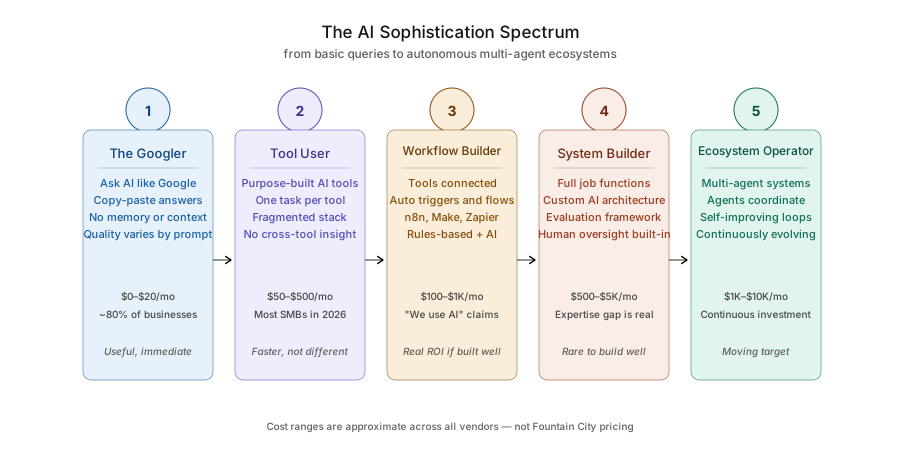
The Five Levels of AI Sophistication
Level 1: The Googler
You ask ChatGPT questions the same way you’d ask Google. You copy the answer, maybe clean it up, paste it into a document or email. Sometimes you use it to brainstorm, draft a first pass, or explain something you’d otherwise have to research.
This is where most businesses sit in 2026. It’s useful. It genuinely saves time. And for many tasks, it’s all you need.
The limitation is consistency. Every interaction starts from scratch. There’s some memory from past chats, but no deep memory of your business, your customers, or your processes. The quality of what you get depends entirely on the quality of what you ask, and that skill lives in one person’s head. If your best prompt writer leaves, the capability walks out with them.
Level 2: The Tool User
You’ve adopted specific AI tools for specific jobs. An AI writing assistant for marketing content. A transcription service for meetings. A code completion tool for your developers. Maybe an AI-powered CRM feature or a chatbot on your website.
Each tool handles one task well. You’re faster across several functions. This is a real improvement over Level 1 because the tools are purpose-built, which means the outputs are more reliable than general-purpose prompting.
The limitation is fragmentation. Each tool is a point solution. They don’t talk to each other. Your AI transcription tool doesn’t feed insights into your CRM. Your content tool doesn’t know what your sales team is hearing from prospects. You’ve added AI capabilities, but you haven’t changed how your business operates.
A client of mine experienced the downside of this level firsthand. They set up an AI chat system on their website, trusted the vendor who built it, did zero testing, no guardrails. After a month, it was telling customers the wrong thing, damaging the brand. The owner pulled it down, furious, and decided AI was all hype. The real problem wasn’t the technology. It was a half-baked implementation from a seller who overpromised and a buyer who couldn’t evaluate what they were getting.
Level 3: The Workflow Builder
You’ve connected tools into automated sequences. Data flows between systems. Triggers fire automatically. When a form submission comes in, it gets routed, scored, and followed up on without someone manually moving information between tools. You’re using platforms like low-code builders, n8n, Make, or Zapier with AI nodes wired in — or working with a team that builds custom AI workflows tailored to your operations.
This is where most “we use AI” claims actually land. It’s genuinely valuable. Repeatable processes run faster and more consistently. But the automation is still rules-based at its core, with AI handling individual steps. If the workflow breaks because an upstream system changes its API, someone has to notice and fix it manually.
Most companies that say they’ve “implemented AI” are operating here. And for many, this is the right level. The ROI on well-designed workflow automation is real and measurable.
Level 4: The System Builder
You’re building custom AI systems that perform entire job functions. Not “summarize this email” but “handle the complete customer onboarding process from first contact to setup completion.” Not “draft a blog post” but “research the topic, write the draft, review it against brand standards, generate images, and prepare it for publication.”
This requires architecture thinking: how do components connect, how does the system fail gracefully, how do you evaluate whether the output is actually good? It requires designing human oversight, because the system is making decisions that have business consequences. And it requires domain expertise, because someone has to know what “good” looks like in order to build a system that produces it.
Level 4 is where the expertise gap becomes obvious. The tools available at this level are often the same tools available at Level 2: ChatGPT, Claude, open-source models. The difference isn’t the technology. It’s knowing how to orchestrate it into something that runs reliably in production.
Think of it this way: WordPress is free. You can install it in five minutes. But building a profitable digital business on WordPress requires design skills, content strategy, SEO knowledge, conversion optimization, security hardening, and years of iteration. The gap between “I installed WordPress” and “I built a business on WordPress” is expertise, not software. The same gap exists between “I use AI tools” and “I run AI systems.”
Level 5: The Ecosystem Operator
You run a continuously evolving multi-agent ecosystem. Multiple specialized agents coordinate with each other. The system incorporates feedback loops that improve output quality over time. New capabilities emerge from existing infrastructure as you add components.
We have systems across all levels but mostly at Level 4 and 5. Our production system handles end-to-end content operations: from research through to publication, autonomously, with human reviews at defined checkpoints. It works, and it keeps getting better as we iterate. But claiming you’ve “arrived” at Level 5 would be dishonest. This is a moving target, and the honest framing is that we’re further along this path than most because we’ve spent months building, failing, rebuilding, and measuring.
The ongoing investment at this level is real. It’s not a one-time build. Models change, capabilities shift, processes need refinement. If you’re not prepared for continuous iteration, Level 4 with periodic upgrades is a more sustainable goal.
The Expertise Gap Nobody Talks About

A prospective client came to us last year looking for a team to architect their enterprise systems: AI knowledge stores, dynamic meeting minutes that auto-generate FAQ entries and follow-up actions, integrated analytics. Significant, complex work. The boss decided instead to hire someone out of school to build it all “with AI.” Everyone in the room looked at each other, confused.
The pattern is basically: The gap between what AI can theoretically do and what buyers think they’re purchasing has never been wider. Technology is moving so fast that the usual partnership between buyer and seller is breaking down. Normally, a seller communicates their value, a buyer compares offers and selects the best fit. But if the buyer can’t evaluate the difference between two offers, or even understand what the offer is, the seller who delivers the shiniest pitch for the lowest price wins. And then burns their customer on the technology itself.
It’s like a company that has never owned vehicles deciding to buy a single used van for $5,000 when what they actually need to move goods across the country is a fleet of twenty trucks. They’re thrilled to have the van because they’ve never had anything. They might only realize the van won’t cut it after months of failed deliveries. Or worse, they might decide transportation itself is the problem and stop trying entirely.
The failure data supports this. According to MIT’s 2025 NANDA report, 95% of generative AI pilots fail to achieve measurable impact. IDC research found 88% of AI proofs-of-concept never reach production. These aren’t technology failures. They’re expertise gaps: the wrong system for the problem, no evaluation framework, no production plan, no one who knows what “done well” actually looks like.
Normally I’d say the market will catch up. Buyers will learn. But will it? More powerful models are coming out so fast that with each release, the scope of what’s possible expands dramatically. The gap between what a sophisticated buyer can achieve and what an uninformed buyer settles for is getting wider, not narrower. For a buyer to keep up, they need to build a deep trust relationship with experts who are tracking the technology closely enough to provide real value.
How to Place Yourself on the Spectrum
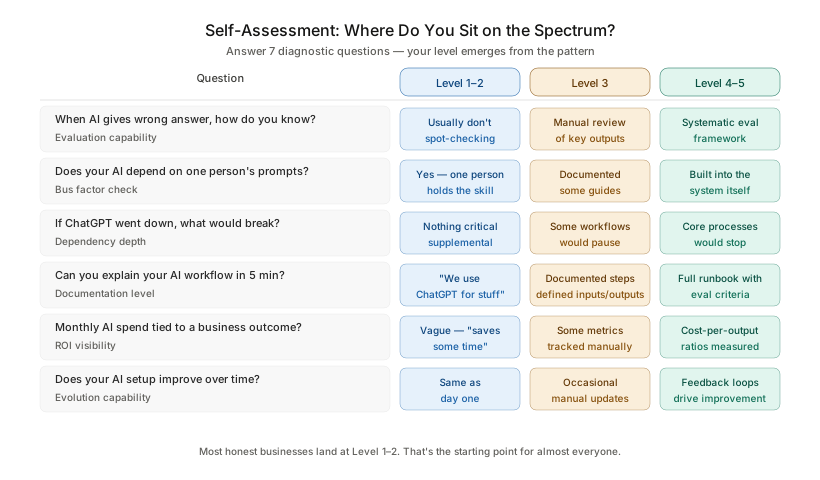
Seven diagnostic questions. Answer honestly. hopefully fun 🙂
1. When your AI tool gives a wrong answer, how do you know? If the answer is “I usually don’t,” you’re at Level 1-2. Evaluation capability is the single biggest differentiator between levels. At Level 4+, there’s a systematic way to assess output quality that doesn’t depend on a person’s judgment.
2. Does your AI usage depend on one person’s prompt skills? If your best results come from one team member who’s good at prompting, you have a bus factor problem. Levels 3+ encode the expertise into the system itself, so output quality doesn’t fluctuate with who’s operating it.
3. If ChatGPT went down tomorrow, what would break in your business? If the answer is “nothing critical,” your AI usage is supplemental, not operational. If the answer is “several core processes would stop,” you’ve built real dependency, which means you need real reliability engineering.
4. Can you describe your AI workflow to a new employee in under five minutes? If it’s “we use ChatGPT for stuff,” that’s Level 1. If you can walk someone through a documented process with defined inputs, steps, and outputs, you’re at Level 3 or above.
5. What’s your monthly AI spend, and can you tie it to a business outcome? Level 1–2 typically costs $20–$100 per person per month in tool subscriptions, with ROI that’s felt but rarely measured. Level 3+ has measurable cost-to-output ratios. Understanding AI agent ROI requires this kind of specificity.
6. Have you ever caught an AI output that “looked right” but was subtly wrong? This is quality awareness. If you’ve caught subtle errors, you understand why evaluation matters. If you haven’t, either your AI use is too casual for errors to matter, or the errors are getting through and you don’t know it.
7. Does your AI setup get better over time, or is it the same as day one? Level 1-2 is static. You get the same capability month after month. Level 3+ improves through refinement. Level 4-5 is designed to improve systematically through feedback loops, monitoring, and iteration.
Most honest businesses will land at Level 1-2. That’s not a criticism. It’s the starting point for almost everyone.
When You Actually Need Professional Help (And When You Don’t)
Stay at Level 1-2 if your needs are ad-hoc, your volume is low, your tolerance for imperfection is high, and the tasks don’t involve high-stakes decisions. A solo consultant who uses ChatGPT to draft proposals and summarize research is well-served at Level 1. A small marketing team using Jasper for first drafts is well-served at Level 2. There’s no reason to over-engineer this.
Consider Level 3 if you have repeatable processes that consume significant time, some technical capability in-house, and can invest weeks (not days) in building and maintaining workflows. This is achievable DIY with the right people. A growing e-commerce business that automates order processing, customer follow-ups, and inventory alerts can build this with existing low-code platforms. The key question is whether you have someone who can maintain it when things break.
Level 4-5 typically requires outside expertise if the outputs have business consequences, you need production reliability, you don’t have deep AI architecture experience in-house, and you want the system to evolve. This is where hiring a professional is genuinely correct. Not because the tools are expensive, but because the expertise to orchestrate them into reliable production systems is rare. Understanding what an AI agent actually is (and isn’t) is the starting point for these conversations.
How do you evaluate who to hire? The single best signal is whether they run their own systems in production. Not for clients. For their own business. Ask them: what autonomous AI systems do you operate daily? What breaks, and how do you handle it? What’s your actual monthly cost per agent? If they can’t answer with specifics, they’re selling theory. A comparison of AI agent development companies helps, but the transparency test is what separates practitioners from pitch decks.
The Real Cost of Each Level
What each level actually costs, including the parts most people don’t account for:
| Level | Tool Cost | Expertise Needed | Time to Value | Hidden Cost |
|---|---|---|---|---|
| 1. The Googler | $0–$20/mo | None, but how to prompt and governance policies are important | Immediate | Inconsistent quality, no accountability, single-person dependency |
| 2. The Tool User | $50–$500/mo | Per-tool learning curve | 1–4 weeks | Tool fragmentation, vendor lock-in, no cross-tool intelligence |
| 3. The Workflow Builder | $100–$1,000/mo | 2–4 weeks setup, ongoing maintenance | 1–3 months | Maintenance burden, brittle when upstream systems change |
| 4. The System Builder | $500–$5,000/mo | 1+ Month of architecture work | 3–6 months | Evaluation framework debt, quality control design, human oversight systems |
| 5. The Ecosystem Operator | $1,000–$10,000/mo | Continuous improvement cycle | Ongoing | Requires domain expertise at every level, constant model evaluation |
These are realistic ranges, not pricing for any specific vendor. For context, professional autonomous AI agent builds typically start in the mid-five-figures for setup with ongoing management fees that scale with complexity. The hidden costs column is what most people miss — and it’s often what determines whether an investment at a given level actually pays off.
The Trust Problem
There’s a fundamental challenge in this market that I don’t think gets discussed enough. The usual buyer-seller dynamic requires the buyer to be able to compare offers. You look at three proposals, understand what each one is offering, and pick the best fit for your needs and budget.
That dynamic breaks down when the buyer can’t evaluate what they’re looking at. If you’ve never operated above Level 2, you have no frame of reference for what Level 4 looks like. A vendor pitching Level 4 capabilities and a vendor pitching a dressed-up Level 2 with better marketing might sound identical to you. The one with the lower price and the shinier slide deck wins. And then the buyer gets burned, blames the technology, and tells everyone AI doesn’t work.
I’ve seen this play out repeatedly: companies buy the wrong thing, get poor results, and conclude the entire category is overhyped, never realizing the problem was a mismatch between what they bought and what they needed.
The practical filter is finding vendors who are honest about the spectrum. Someone who tells you “you probably only need Level 2 right now” is more trustworthy than someone who insists you need the full platform. Assessing your AI readiness before buying anything is the single most valuable thing you can do.
Frequently Asked Questions
Can I implement AI myself without hiring a company?
Yes, for Levels 1-3. Most businesses can get significant value from ChatGPT and integrated AI tools without any outside help. Level 3 workflow automation requires some technical capability but is achievable in-house with platforms like Make or n8n. Levels 4-5 typically require specialized expertise in AI system architecture, evaluation frameworks, and production operations.
How do I know if I’m ready for autonomous AI agents?
Key readiness signals: you have repeatable processes with clear success metrics, tolerance for iteration (this isn’t “set and forget”), and the budget for ongoing management. If you can describe a specific job function you want automated end-to-end and you can define what “done well” looks like, you’re ready to explore it. Our AI readiness evaluation framework provides a structured way to assess this.
What’s the difference between AI tools and AI systems?
Tools perform individual tasks: summarize, generate, classify, transcribe. Systems coordinate multiple capabilities to perform complete business functions autonomously. The gap between them is architecture, evaluation, and domain expertise, not technology. The tools inside a Level 4 system are often the same tools available to everyone at Level 2.
Is hiring an AI company worth it for a small business?
Depends on what level of sophistication you need. For Level 1-2 needs, no. Use ChatGPT and off-the-shelf tools. For Level 4-5 needs where outputs have business consequences and you need production reliability, typically yes. The cost of learning by trial-and-error often exceeds the cost of working with someone who has already made those mistakes.
How much does professional AI implementation cost?
Wide range depending on the level. Custom AI workflow implementations (Level 3) can run a few thousand dollars. Multi-agent systems (Level 4-5) are a significantly larger investment — setup plus ongoing management fees that scale with complexity. The right answer depends entirely on which level of sophistication you actually need and whether you have the in-house expertise to maintain it.
What should I ask an AI implementation company before hiring them?
Three questions that separate practitioners from salespeople: What autonomous AI systems do you run in your own business operations, not just for clients? Can you show me real outputs from those systems, including failures and how you handled them? What’s your actual monthly cost per agent in production? Transparency about their own operational reality is the best signal you’ll get.

Where to Start
If you’ve read this far, you probably have a sense of where you sit on the spectrum. The honest next step depends on that answer.
If you’re at Level 1-2 and happy there, stay. Get better at prompting, explore tools that fit your specific workflows, and revisit the spectrum in six months as models improve.
If you’re at Level 2-3 and want to move higher, start by documenting your most time-consuming repeatable processes. The AI readiness evaluation gives you a structured way to identify which processes are good candidates for automation and whether your organization is ready.
If you’re at Level 3 and hitting limits, the jump to Level 4 is where outside expertise typically pays for itself. Not because the tools are different, but because the architecture, evaluation, and operational patterns require experience that’s hard to develop from scratch without burning months and budget on avoidable mistakes.
The spectrum isn’t a ladder you have to climb. It’s a map. The value is in knowing where you are and making a deliberate choice about where you want to be.