What MCP, A2A, and UCP Mean for Your Website in 2026
If you run a website in 2026, you have probably watched three different articles about MCP, A2A, and UCP scroll past in the last two weeks and wondered whether any of it changes what you should be doing this quarter. The short answer is yes, but probably less than the headlines suggest, and not in the direction the headlines point. The agentic protocol stack is real infrastructure that is now mainstream conversation, and most of the work the average website owner needs to do about it can be done in an afternoon.
Three sources published the same underlying observation within roughly two weeks of each other. Backlinko released a six-protocol primer on MCP, A2A, NLWeb, WebMCP, ACP, and UCP, framing them as “what robots.txt and XML sitemaps were to 2005 Google.” Addy Osmani, Google Cloud’s Director of Engineering, published an Agentic Engine Optimization framework along with an open-source audit tool. Conductor analyzed 13,770 domains and 17 million AI responses and named the resulting visibility layer “the parallel surface.” Three independent signals, same conclusion. Agentic protocols are now part of how websites get discovered, queried, and (eventually) transacted with by AI agents on behalf of their users.
This article is the version for the person who runs a website and wants to know which of these protocols matter for their site, which ones they can ignore, and what is reasonable to actually do about any of it before the end of the quarter.
What “Protocol-Ready” Means
Protocol-ready means an AI agent can discover, query, and (where it makes sense) transact with a website through a standardized interface, instead of scraping HTML and guessing at structure. That is the whole definition.
The closest historical parallel is the one Backlinko reaches for and gets right. Their verified framing: “Think of how robots.txt and XML sitemaps became table stakes for search crawlers. Agentic protocols are shaping up to be that for AI agents.” Robots.txt was a quiet text file that turned into existential SEO infrastructure within three years of nobody caring about it. The trajectory of the agentic protocol stack looks similar, though earlier on the curve.
The signal that this is now mainstream rather than speculative is convergence. DigitalApplied’s ecosystem map reports 97 million MCP downloads as of March 2026. Backlinko’s count of the PulseMCP directory has more than 10,000 MCP servers live as of early 2026. Conductor’s 2026 benchmark finds AI referral traffic averaging around 1% of total website traffic and growing roughly 1% per month. The 1% number is small, but the growth rate is the part to watch. The infrastructure has reached the volume where ignoring it stops being defensible, even if acting on it is still optional for most sites.
For the content-side companion to the infrastructure questions in this article, see our agentic SEO practitioner guide, which covers what to publish so AI agents can actually use it.
The Three Protocols That Matter Now (and the Three to Watch, Not Build For)
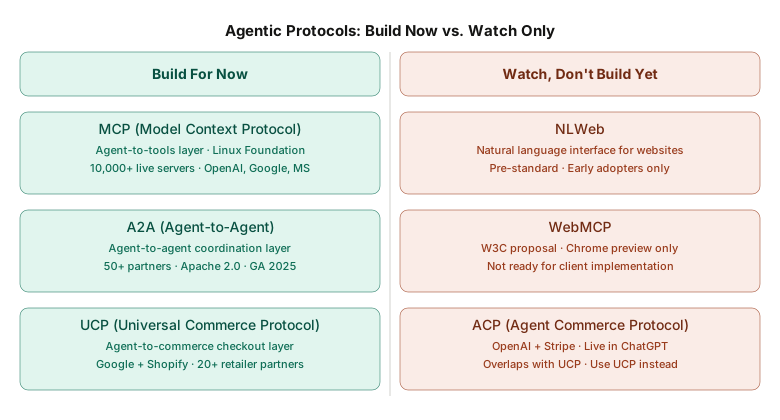
Backlinko enumerates six protocols. The count is correct as a taxonomy, and misleading as a buying recommendation. For 2026 website-scale decisions, three deserve real attention. Three more are worth tracking and nothing more.
Build for now
MCP (Model Context Protocol). The agent-to-tools layer. Anthropic launched MCP in November 2024, and it is now governed by the Agentic AI Foundation under the Linux Foundation. The standard has been adopted by OpenAI, Google, and Microsoft. If your business has any internal system you would want AI tools to query (a product catalog, a CRM, a CMS, a support knowledge base, an inventory database), an MCP server is the standard interface for exposing that system to agents. It is the only protocol on this list that has cleared “is this real” status. If you have nothing for an agent to query, you do not need MCP.
A2A (Agent-to-Agent). The agent-to-agent layer. Google launched A2A in April 2025 with more than 50 technology partners, including Salesforce, PayPal, SAP, Workday, and ServiceNow. The Linux Foundation now maintains it under Apache 2.0. A2A becomes relevant when a website operates more than one agent that needs to coordinate with another agent (yours or someone else’s). Most websites are not running multiple agents yet. If you are running one agent or none, A2A is informational. If you reach three or more by the end of 2026, you will need it.
UCP (Universal Commerce Protocol). The agent-to-commerce layer. Sundar Pichai announced UCP at NRF 2026, co-developed by Google and Shopify with launch partners including Target, Walmart, Wayfair, and Etsy, plus 20+ additional partners including Mastercard, Visa, Stripe, and American Express. UCP runs on top of OAuth 2.0 and PCI-DSS, with MCP and A2A bindings built in. UCP launched less than 14 weeks after OpenAI and Stripe announced ACP, the competing OpenAI-led commerce protocol. The two protocols overlap. UCP has the broader retailer coalition; ACP has live distribution inside ChatGPT. If your site sells products and you are picking one to keep on your radar today, UCP is the safer bet on coalition breadth.
Watch, do not build for yet
NLWeb. A natural-language interface for websites, created by R.V. Guha, who also created RSS, RDF, and Schema.org. Heavy pedigree. Early adopters include TripAdvisor, Shopify, Eventbrite, O’Reilly, and Hearst, announced at Microsoft Build 2025. Interesting long-term. Most websites do not need it yet.
WebMCP. A Google-and-Microsoft W3C Community Group proposal, with an early preview shipping in Chrome in February 2026. Pre-standard. Worth watching, not worth implementing this quarter.
ACP (Agent Commerce Protocol). OpenAI and Stripe’s commerce protocol. Live in ChatGPT Instant Checkout since September 2025, with 900 million weekly ChatGPT users and a reported 4% merchant fee per Opascope’s synthesis. Real, but overlapping with UCP. If you only have budget for one commerce protocol implementation, the broader-coalition standard wins on portability.
Run This on Your Own Site: A Five-Point Readiness Check
Most websites only need to act on two or three of the five questions below. The point of running through all five is to know which two or three those are.
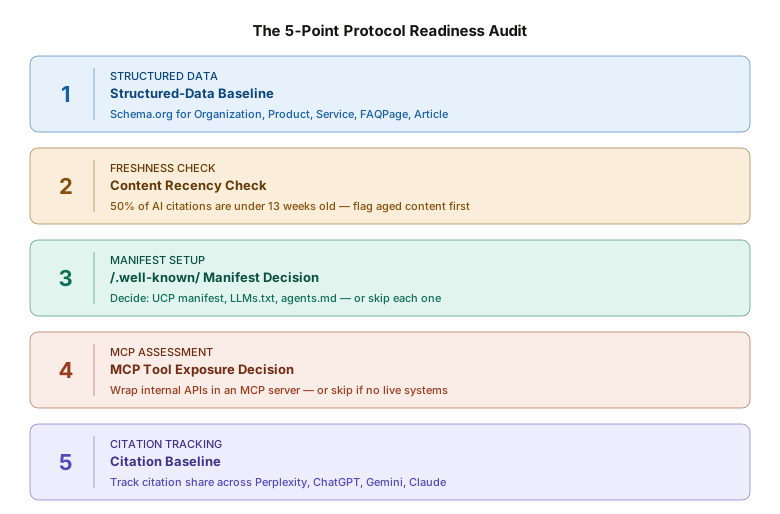
1. Structured-data baseline. Schema.org coverage for Organization, Product, Service, FAQPage, and Article at minimum. If your structured data is incomplete, no protocol implementation will compensate, because agents still need the structured signals underneath. Run Osmani’s agentic-seo audit tool against your own domain. The tool runs ten checks across five categories (Discovery, Content, Token Efficiency, Agent Context, AI Usability) and scores out of 100. Free, public, fifteen minutes. Run it against a competitor’s domain in the same session if you want a calibration point.
2. Content recency check. Amsive reported that 50% of AI-cited content is less than 13 weeks old. If your last cornerstone publish was six months ago, fix that before anything else. Recency is the precondition; protocols are the amplifier. Cornerstone-content cadence is a bigger lever for AI visibility right now than any single manifest decision.
3. /.well-known/ manifest decision. There are three possible manifests, and not every site should publish all three. A UCP manifest at /.well-known/ucp is relevant if you sell products online. An LLMs.txt file is relevant for content-heavy sites that want to expose a curated reading order to AI agents. An agents.md file at the repository root is relevant if your site or codebase is going to be navigated by coding agents. Most sites need one or two of these, not all three. Decide what to publish, not all of it.
4. MCP tool exposure decision. Do you have an internal API, database, or system an agent should reach? If yes, an MCP server wrapping that system is the right pattern. If no, and most brochure-site businesses are in this category, skip MCP entirely this quarter. There is no point building infrastructure for agents to use when there is nothing for them to use it for. If you do expose an internal system, build a cost circuit breaker pattern in front of it before going live. Runaway agent calls produce surprise bills.
5. Citation baseline. Before any protocol work, measure where your site is currently being cited in AI answers across Perplexity, ChatGPT, Gemini, Claude, and Google AI Mode. Conductor’s 2026 AEO/GEO Benchmarks, built on 13,770 domains and 17 million AI responses, give you the industry calibration. AI referral traffic averages around 1% of total and is growing roughly 1% per month. If you do not measure where you are cited today, you cannot tell whether anything you do tomorrow is working.
Five questions, answerable in an afternoon. Most websites only need to act on two or three of them.
When you can skip this entirely. Sites with fewer than 50 indexed pages, sites in regulated verticals where agent transactions are not yet legal (regulated financial advice, healthcare prescribing, anything that requires a licensed human in the loop), and sites whose current content strategy is not producing anything citable in the first place. The structured-data and content-recency checks above will surface this quickly. If both fail, fix those first; the protocol questions can wait.

Where This Is Going (and What to Do About It)
The trajectory is directionally certain and short-term modest, and that is the framing to take into your next planning meeting. Backlinko, Pipe17, and the Google Developers Blog all published their protocol primers in Q1 2026. Search Engine Journal, SEMrush, and Ahrefs will follow this year. Conductor has already named “the parallel surface of visibility” as the canonical 2026 framing. Protocol-readiness is going to show up as a normal RFP requirement on a 12-to-24-month horizon, not a “by July” deadline. The current AI-referral share is small. The growth rate is the part that compounds.
What is reasonable to do now if you run a website. Run Osmani’s agentic-seo tool on your domain (15 minutes). Audit your cornerstone content recency (1 hour). Decide whether you have an internal system that would benefit from MCP exposure (most websites do not, and “no” is a perfectly reasonable answer). If you sell products online, put a calendar reminder to revisit the UCP manifest question in Q3, when the retailer adoption curve will be clearer. None of this is a multi-quarter program. It is afternoon-scale work for most sites, and skip-entirely work for many of them.
We are a technology studio that builds autonomous AI systems. The readiness work in this article sits in front of the platform layer we run for clients with bigger needs (clients running production agents, exposing internal systems through MCP, or building multi-agent workflows that coordinate over A2A) at Fountain City’s managed autonomous AI agents.
FAQ
What is MCP (Model Context Protocol)?
MCP is the standardized interface AI agents use to talk to tools and data sources. Anthropic launched MCP in November 2024, and it is now governed by the Agentic AI Foundation under the Linux Foundation, with adoption from OpenAI, Google, and Microsoft. According to Backlinko’s count of the PulseMCP directory, more than 10,000 MCP servers are live as of early 2026. Practically, if you have an internal system an AI tool should query, an MCP server is the standard wrapper.
What is UCP (Universal Commerce Protocol)?
UCP is the agent-to-commerce protocol announced by Google and Shopify at NRF 2026. Launch partners include Target, Walmart, Wayfair, Etsy, Mastercard, Visa, Stripe, and American Express, with 20+ additional partners endorsing the standard. UCP runs on OAuth 2.0 and PCI-DSS and includes MCP and A2A bindings. It exists so AI agents can complete purchases on behalf of shoppers using a standardized handshake instead of brittle scraping.
What is the difference between MCP, A2A, and UCP?
MCP connects agents to tools and data. A2A connects agents to other agents. UCP connects agents to commerce checkout. Different layers of the same stack, and most websites only need one or two of them.
What does “protocol-ready” mean for a website?
Protocol-ready means an AI agent can discover, query, and (where it makes sense) transact with the site through a standardized interface, instead of scraping HTML and guessing at structure. Concretely: structured-data coverage in place, recent cornerstone content, the right /.well-known/ manifest published, and (if internal systems are involved) an MCP server with auth and rate limits.
Is this the same as GEO or AEO?
Adjacent, not identical. GEO (Generative Engine Optimization) and AEO (Answer Engine Optimization) are about optimizing content to be cited by AI engines. Protocol readiness is the infrastructure layer underneath that. The standardized interfaces agents use to discover, query, and transact with a site. The five-point readiness check covers both, because the questions overlap.
Does my site need all six protocols?
No. For 2026 decisions, three matter (MCP, A2A, UCP), and three are worth tracking but not building for yet (NLWeb, WebMCP, ACP). Most websites only need one or two of the build-for-now three. The five-point readiness check is the way to figure out which.
When can I skip this entirely?
Sites with fewer than 50 indexed pages, sites in regulated verticals where agent transactions are not yet legal, and sites whose current content is not producing anything citable in the first place. If the structured-data and content-recency checks both fail, fix those first; the protocol questions can wait.