
GEO Measurement: The KPIs That Generate Actual Results (Not just vanity metrics)
The dominant question in generative engine optimization right now is whether your brand shows up in AI answers. The harder, more useful question is whether the AI recommends you when a buyer asks the comparison prompt that ends the decision. Those two outcomes are decoupled. The same AI conversation can pull a quote from your site and then, in the next breath, recommend a competitor to the same user.
That gap between being cited and being recommended is what the published GEO measurement frameworks tend to overlook. They count citations, average them across engines, and report a single “visibility score.” All three moves erase the signal you actually need.
I believe this is a leftover from SEO where getting cited was enough because then people would click search results. With GEO your customer is having an entire conversation with AI, and doing all the funnel stages off-line. They are learning about their problem/need, comparing competitors and then ultimately selecting their vendor without ever leaving a chat window.
Getting cited isn’t enough, you need to be recommended by the AI as the best or at least one of the best options in class.
The measurement gap is a targeting problem, not a tooling problem

If getting recommended or not wasn’t enough… 62% of marketing leaders say they cannot measure the ROI of their AI search optimization efforts, according to a 2025 Conductor survey, reported via GenOptima. The default reading of that number is that the field is under-tooled — that better dashboards or more granular tracking would close the gap.
However to add salt to the wound… the published frameworks are not failing to measure enough things. They are mostly measuring the wrong outcome.
The leading guides (GenOptima’s six-KPI framework, UpGrowth’s seven KPIs, Stellar’s three-tier model, Digital Bloom’s ROI procedure) each capture a real piece of the measurement stack. Read together, they recommend:
- Citations
- Mentions
- Sentiment
- Share of voice
- Position
- Source coverage
…and a half-dozen named composites. What none of them resolve is the distance between an AI answer that quotes you, and an AI answer that recommends you.
Being cited is not being recommended — and the AI knows the difference
A buyer asks Claude: “What’s the best AI consulting firm for mid-market manufacturers in the Pacific Northwest?” The answer pulls a quote about regional manufacturing trends from your blog post. The same answer, two sentences later, recommends three competitors as the firms to actually contact.
You got the citation. You did not get the recommendation. The user closes the tab and starts emailing your competitors.
This pattern is more common than the citation-counting frameworks acknowledge. Citation and recommendation are decoupled outcomes — they are produced by different parts of the AI’s reasoning, draw from different signals on your site, and respond to different optimizations. Most published frameworks treat citation rate as the headline KPI. It is a leading indicator at best. It tells you the AI knows something about you. It does not tell you the AI picks you when the question gets to the comparison stage.
The right primary KPI is recommendation rate at buyer-intent prompts. Not “does the engine mention your brand somewhere in a 600-word answer about the industry” but “does the engine name you when a real buyer asks the question that ends in a purchase decision.” That requires building a prompt set that mirrors the comparison questions your buyers actually ask — not the head terms you would target in traditional SEO, and not the broad industry queries that produce friendly mentions without conversion intent.
A useful working definition: track recommendation rate as the percentage of buyer-intent prompts in which an AI engine names your brand as a recommended option (not merely cites a source from your domain). Measure per engine, across a stable prompt set you can re-run monthly. For teams running thought-leadership programs that aim higher up the funnel, the same measurement works at the awareness stage — “what should I read about ____” prompts where the recommendation is to subscribe, watch, or follow rather than to buy. The mechanic is the same; the prompt set changes.
Citation rate still matters as a leading indicator. It usually predicts which brands will eventually become recommendation candidates. But reporting citation rate without recommendation rate is reporting the dress rehearsal as if it were opening night.
Per-engine spread is the load-bearing KPI — aggregate scores lie
Profound’s analysis of 100,000 prompts across ChatGPT and Perplexity found that 89% of AI citations come from different sources depending on which engine the user queried, and only 11.0% of domain citations appeared in both models.
Try to avoid tools that display only your “AI visibility score” across engines as an averaging. The aggregate number tells you nothing about which engine your buyers are using, which engine you are losing on, or which engine your next content investment should target.
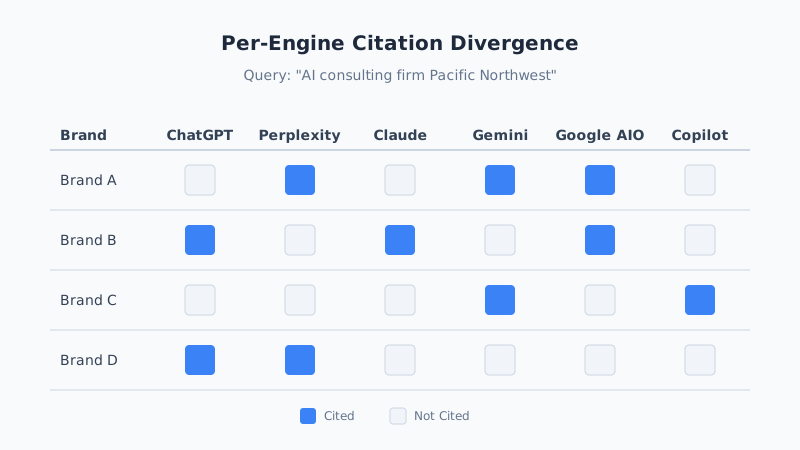
What to track instead, in three slots: per-engine citation rate, per-engine recommendation rate, and the variance across them as its own metric. Call that last one per-engine spread. A brand with a 40% recommendation rate on Perplexity and a 5% rate on ChatGPT has a per-engine spread that tells you exactly where the optimization work needs to go.
Per-engine spread also doubles as a noise check on vendor reports. If a tool gives you a single composite score and refuses to break it down by engine, the report is functionally unverifiable. You cannot act on a number you cannot decompose.
The three KPIs that survive contact — and how to rank them

There are only 3 core KPIs you can and should really be tracking. All the others: citation rate, share of voice etc. are often just vanity metrics that don’t result in actual conversions:
- Recommendation rate at buyer-intent: the conversion-stage signal. This is the synthesis layer, track it per engine and per topic.
- Competitors mentioned: How many competitors are mentioned, spread again per engine.
- Sentiment: the qualities and tone of how the AI describes you. How does the AI rank you against others? What are your known weaknesses and when does it recommend against your business?
Increasing Recommendation Strength
One you have a solid understanding of who is being recommended, how often that is you, and in what light you are viewed by AI Engines you can start to take action.
Common areas to focus on:
- Your business is missing information people want to know
- AI doesn’t know the answer to a client’s question, so they can’t recommend you
- Your data on your website is not specific enough, leading to other vendors who have specific data being recommended
Some tips on how you can increase coverage:
- Load in all your customer sales inquiries and look at that data to determine if all their questions are also on your website
- Create customer profiles and use these to generate synthetic questions, then answer them on your website
- Run AI Agents with your client persona with the mission of finding a provider/seller and then audit the results of their journey, apply the learnings
- Check your site against schema validation and add elements to your website that are missing from the schema review
- Build a network of listicles and reviews from 3rd party sites that strengthen your brand
- Review all the fanout queries from all research performed by each AI query and then turn those into your SEO targets. These are often long-tail phrases with very low competition and they are the queries AI is using to research and make its determinations
Closing Thoughts
People are using AI to help them make purchasing decisions, this will only continue to increase both in the number of people using AI for this, as well as how much of their purchasing process they relegate to AI engines. AI is taking over the brain-power people used to use to filter and select their best options.
This means the process of that decision making is becoming more opaque. Don’t get distracted by vanity KPI theater; where you start measuring how often your stats are quoted by an AI, only to wonder why your sales are down.
Understanding how AI makes decisions, and then being able to demonstrate to your customers the value you are bringing them is challenging now. But I believe if you focus first and foremost on the money (what actually makes a difference) you can use this as your beacon to navigate through the wires of AI noodle-brains and get the results your customers actually want and need.
FAQ
How many AI engines should you track for GEO measurement?
Track the engines your buyers actually use, then layer in the engines whose citations propagate to other models. For most B2B audiences in 2026 that means ChatGPT, Perplexity, Claude, Gemini, and Google AI Overviews as the core five, with Copilot and Grok as secondary depending on audience. Tracking fewer than three means you cannot measure per-engine spread, which is the whole point.
What is a good GEO citation rate to aim for?
Citation rates are only a measure of how often your brand is mentioned, they do not track how often your brand is recommended. If your goal is to get actual recommendations, shift away from trying to get more citations and instead focus on getting recommended.
Can you measure GEO without expensive tools?
Yes, especially for a single business. A weekly spreadsheet covering 10 prompts across three engines produces enough signal to learn the shape of your engine-by-engine picture. Most of the work you need to do is foundational, GEO tracking tools are useful to then know how often you are being recommended, per prompt and per customer-category.
How does GEO measurement differ from traditional SEO measurement?
Traditional SEO measurement assumes a single engine and a clickable ranking as the outcome. GEO measurement runs on different assumptions. The practical differences:
- Multiple engines, no consensus. The engines disagree with each other on which sources to cite, so per-engine reporting becomes non-negotiable.
- Recommendation events replace clicks as the conversion signal, because the primary outcome no longer produces a click.
- Attribution requires explicit channel-grouping work in analytics, because AI-referred traffic does not always carry a recognizable referrer.
- Keyword ranking still matters for fanout queries that AI conversations trigger, but it stops being the headline number. If you want to get recommended, show up in the fan-outs.