
Hermes Agent vs OpenClaw: When to Use Which (and When to Use Both)
Businesses comparing Hermes Agent and OpenClaw treat it as a winner-loser question. They are not competing for the same job. They are different layers of the same stack, and in our experience the right architecture for most agentic systems runs both, nested together, with Hermes driving and OpenClaw containing.
Architectural disagreement
Hermes Agent and OpenClaw share a lot of surface area. Both run on your own devices, connect to messaging channels, schedule cron jobs, store persistent memory, delegate to subagents, and integrate browser and terminal tools. Read the feature lists side by side and you would conclude they are competitors.
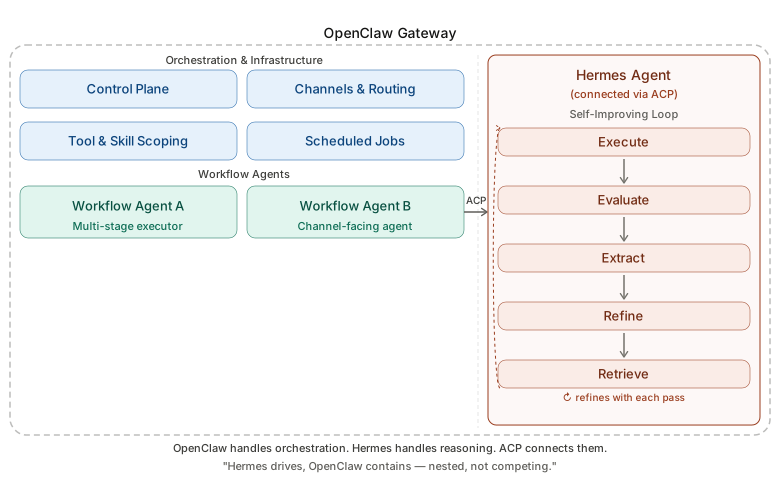
They are not, because they disagree on what the center of an agent system should be. Hermes is built around a closed learning loop: the agent executes a task, evaluates how it went, extracts a skill, refines it during subsequent runs, and retrieves the relevant pieces on future tasks. The agent is the load-bearing element.
OpenClaw inverts that. The center of OpenClaw is the Gateway, the single control plane and node transport for the whole system. Agents are containers the Gateway routes work to. The framework is the load-bearing element, and agents are interchangeable workers inside it.
Where OpenClaw wins
OpenClaw is the right call when the system needs strong containment and predictable workflows more than it needs deep reasoning inside any single agent. Three strengths matter:
- Workflow state control. The Gateway gives you an explicit, inspectable control plane for routing work between stages. When work fails, you know where it failed and what state it was in.
- Agent containerization. Each agent is isolated, with its own workspace, scoped tools, and scoped permissions. One agent cannot accidentally run another agent’s code or read its files.
- Tool and skill scoping. You declare which tools each agent can call. A research agent does not get write access to your CRM. A social-media agent does not get shell access to production.
The shape of the work matters more than the agent’s IQ. If the job is “run this five-stage pipeline every day, route failures to a human, and never let stage three write to production without approval,” OpenClaw is built for that.
Where Hermes wins
Hermes is the right call when the value of the system depends on what happens inside a single agent’s reasoning rather than on the workflow that connects multiple agents.
The differentiator is the self-reflective execution loop. Hermes does not just run tasks. It captures what worked, packages it as a reusable skill, improves the skill over time, and recalls the right piece of memory at the right moment. Nous Research describes Hermes as “the only agent with a built-in learning loop”.
That difference compounds on two task types:
- Long-horizon work picked up across sessions. Multi-week projects where context drifts and “what did we decide last time?” is the most-asked question. Hermes is built to remember.
- Higher-order reasoning with tight tool chaining. Tasks where the agent has to plan, execute a tool, evaluate the result, choose a different tool, and iterate. OpenClaw can do this, but the loop is not first-class. In Hermes, the loop is the agent.

What is ACP
The Agent Communication Protocol is what makes running both frameworks together a real architectural choice rather than a duct-tape job.
ACP is a standard for how one piece of software talks to an AI agent. The agent runs in one process. Something else, an editor or a framework or an orchestrator, runs in another. ACP defines the message format between them, so the client can send work, watch progress, see which tools the agent is using, approve sensitive actions, and receive responses. Hermes adopted ACP early and can run as an ACP server any ACP-compatible client can drive.
That last detail is the unlock. If Hermes can run as an ACP server, anything that speaks ACP, OpenClaw included, can use a Hermes agent as a node inside a larger system.

The “Hermes drives, OpenClaw contains” pattern
In an agent system where you need both workflow containment and self-reflective reasoning, you nest them.
OpenClaw is the outer container: control plane, messaging channels, scheduled jobs, multi-agent routing, tool and skill permissions. Inside, most agents are focused workflow executors. For the agents whose value depends on reasoning and learning over time, you run a Hermes agent as a node, exposed over ACP.
A concrete example: an outbound ABM system. The orchestration, sequencing stages, managing timing between touches, handling bounces, routing hot responses to a human, is OpenClaw’s job. The reasoning inside research and personalization is where Hermes earns its place. For each target account, Hermes builds a living profile: who the real influencers are, what language resonates, which angles have gotten traction. Each interaction feeds back into the profile. Over time, Hermes develops a sharper model of each account.
Hermes drives the reasoning inside the work. OpenClaw contains it.
The nest works in both directions
“Hermes drives, OpenClaw contains” is one configuration. The inverse is just as valid: Hermes on the outside, managing a set of OpenClaw agents underneath.
The inverted nest fits when the orchestration itself is the part that needs to learn. If which agent to call, in what order, when to escalate, when to short-circuit are decisions that change run over run, your orchestration is itself a reasoning problem.
The system can also become recursive. An outer Hermes orchestrates a set of OpenClaw workers, and one of those workers is itself a Hermes agent doing self-reflective work inside its assigned step. Two layers of Hermes, one of OpenClaw between them.
OpenClaw can run a learning loop too
The earlier section called OpenClaw substantially weaker at the self-reflective loop. That is true if you measure the two frameworks on the same job. It is not the same as saying OpenClaw cannot learn.
OpenClaw supports self-reflection and real-time skill development. The agents inside it that benefit are the ones with a clear workflow function, where the learning happens inside the bounds of that workflow. A research agent that improves its source-vetting heuristics. A review agent that catches the tone violation it missed last week. A scheduling agent that learns when to retry versus when to escalate. The workflow stays the same. The agent gets sharper at its assigned role inside it.
That is a different bet. Hermes treats learning as the point of the system: the loop is the agent. OpenClaw treats learning as a feature attached to a particular agent inside a larger workflow. If every agent in your system needs to be a generalist learner, Hermes is the right base. If your system needs structured workflows with a handful of agents inside that get smarter at their assigned roles, OpenClaw does the job. The question is whether learning needs to be the spine of the system or a feature on one of its limbs.
A two-question decision framework
If you are deciding what to build, separate two questions before any vendor pitches you a framework.
- Does the system need workflow containment, or higher-order reasoning inside a single agent? Containment means predictable stages, isolated agents, scoped tools, explicit hand-offs. Higher-order reasoning means a single agent that gets smarter at your specific job over time. Different problems, different solutions.
- Do you need both? If the answer is “actually, both,” which for most production systems past a certain complexity it is, then a nested architecture is the answer. Hermes inside OpenClaw, communicating over ACP.
A quick map: workflow, framework, both, or neither
The two questions above are the high-level frame. For a specific build, a faster method is to match the shape of the job:
- Pure workflow with fixed steps and no learning needed: pick neither framework. Write the code directly. State transitions, a scheduler, deterministic flow. The overhead, the security surface, and the runtime cost of an agent framework do not earn their keep on a workflow this simple. Knowing when not to build an agent system is part of the discipline of building one.
- Workflow that needs to learn and improve, where the steps themselves stay mechanical: OpenClaw. You get the containment, the scoping, and the channel reach, with a learning loop attached to the agents inside. The workflow stays inspectable. The agents get sharper at their roles.
- Multiple outcome goals to balance, with real tradeoffs between them: Hermes. Balancing tradeoffs is reasoning work. The self-reflective loop closes the gap between “what did I do” and “what should I have done given the goals.”
- Loose goal, methods change every run, learning over time is the point: Hermes. Research roles, advisory roles, long-running specialist agents. The looser the goal, the more value lives inside the agent’s reasoning rather than in the workflow that contains it.
Not every workflow inside an OpenClaw deployment has to be an agent. The framework cleanly supports plain workflow code (state machines, scripts, deterministic flows) that engages zero agents and triggers one only when needed. The agent becomes a step inside the workflow rather than the workflow being a step inside the agent. This could be the best solution for a production pipeline, and the reason OpenClaw earns its keep even when most of the work running inside it is not agentic.
Frequently asked questions
What is the main difference between Hermes Agent and OpenClaw?
Hermes Agent is built around a self-improving execution loop inside a single agent. OpenClaw is built around a Gateway control plane that orchestrates multiple agents, channels, and tools. Hermes packages a gateway around an agent. OpenClaw packages agents inside a gateway. The difference is which load-bearing element your system needs.
Should I use Hermes or OpenClaw for my business?
If your system is one specialist agent that gets smarter over time at a specific domain (coding, research, advisory), start with Hermes. If your system is a multi-stage workflow with several agents, different permissions, and messaging channel reach, start with OpenClaw. For most production systems past a certain complexity, the right answer is both, nested.
Can you run Hermes Agent and OpenClaw together?
Yes, and it is the recommended pattern when the system needs both workflow containment and self-reflective reasoning. OpenClaw provides the outer container: control plane, channels, scheduled jobs, multi-agent routing, tool scoping. Hermes runs as a node inside that container, communicating with OpenClaw over the Agent Communication Protocol. Each framework does what it was built for.
Can Hermes orchestrate OpenClaw agents, or does the nest only work the other way?
It works in both directions. The “Hermes drives, OpenClaw contains” pattern is one configuration. The inverse, a Hermes agent on the outside managing a set of OpenClaw agents underneath, is just as valid when the orchestration itself is the part that needs to learn. The nest can go deeper than two layers: a Hermes agent can appear again as a worker inside an OpenClaw layer that sits inside an outer Hermes. The decision is architectural. Which layer needs to reason and which layer needs to contain.
What is the Agent Communication Protocol (ACP)?
ACP is a standard for how AI agents talk to other software like an editor, an orchestrator, or another agent framework. It defines the message format so a client can send work to an agent, watch the agent’s progress, see which tools the agent is using, approve sensitive actions, and receive results. Hermes Agent can run as an ACP server, which is what makes the nested pattern with OpenClaw practical.
Is Hermes Agent better than OpenClaw in 2026?
Hermes currently leads OpenRouter daily traffic, but daily volume measures adoption. Fit is a separate question. OpenClaw still leads in cumulative usage and supports a wider range of messaging channels. Whether one is “better” depends on whether your system needs the self-improving loop or the multi-agent control plane. For systems that need both, neither is better. You run them together.
What is OpenClaw weaker at than Hermes?
OpenClaw is substantially weaker at the self-reflective execution loop: the cycle of executing a task, evaluating the result, packaging it as a reusable skill, refining the skill during subsequent runs, and recalling the right memory at the right moment. OpenClaw can build memory and learning into an agent, but you have to build it. In Hermes, it is the default.
Can OpenClaw run a learning loop like Hermes does?
Yes, with a different scope. OpenClaw supports self-reflection and real-time skill development on agents that have a clear workflow function. The learning happens inside the bounds of that workflow rather than being the spine of the whole system. A research agent that improves its source-vetting heuristics, a review agent that catches the tone issue it missed last week, a scheduling agent that learns when to retry, are all reasonable inside OpenClaw. The honest distinction is whether learning is the point of the system or a feature on one of its agents.
What does OpenClaw do that Hermes can’t?
OpenClaw provides workflow state control, agent containerization, tool and skill scoping, and broad messaging-channel reach as first-class capabilities. Multi-agent systems where different agents have different authority levels, predetermined production workflows with multiple stages, and channel-heavy deployments are the contexts where OpenClaw is structured for the job and Hermes is not.
When should I NOT use Hermes or OpenClaw at all?
When the job is a workflow with fixed steps, mechanical decisions, and no learning needed, skip both. Write the workflow as code: state transitions, a scheduler, deterministic flow. The overhead, the security surface, and the runtime cost of an agent framework do not earn their keep on a simple workflow. Knowing when not to build an agent system is part of the discipline of building one. Reach for a framework only when the work has reasoning, balancing, or learning that mechanical code cannot reach.
Does every workflow inside an OpenClaw deployment need to be an agent?
No. OpenClaw cleanly supports plain workflow code (state machines, scripts, deterministic flows) that engages zero agents and triggers an agent only when one is needed. The agent becomes a step inside the workflow rather than the workflow being a step inside the agent. That is the right shape for most production pipelines and the reason OpenClaw earns its keep even when most of the work running inside it is not agentic.
Which open-source AI agent framework should a non-technical business owner pick?
Before picking a framework, decide what the system needs to do. If it needs predictable workflows across multiple agents, pick OpenClaw. If it needs a single specialist agent that learns your domain over time, pick Hermes. If it needs both, which most production systems past a certain complexity do, pick a vendor who knows how to nest them. The framework is one decision inside a larger build. A single-framework pitch covers only half the architectural questions. Start with a clear definition of the job, then talk to a builder who can match the architecture to it.