Agentic SEO: What It Actually Is and How We Run It in Production
The “Agentic SEO” Category Just Formalized. Most of It Is Mislabeled.
Agentic SEO became an official category in early 2026. Frase rebranded around it. Siteimprove published a definitional guide. Search Engine Land ran a practitioner walkthrough. The term now has its own SERP, its own vendor ecosystem, and its own set of inflated claims.
The working definition is reasonable enough: agentic SEO uses autonomous AI agents to plan, execute, and refine optimization tasks across the full search lifecycle. Instead of a person prompting ChatGPT for keyword ideas and manually updating title tags, an agent monitors performance data, identifies opportunities, generates briefs, writes content, and tracks results on its own schedule.
The problem is scope. Most content using the term “agentic SEO” describes what is really AI-assisted SEO: a human operator using smarter tools. Frase’s content monitoring feature is useful. Search Engine Land’s n8n workflow walkthrough is practical. But connecting a keyword tool to a content optimizer through a no-code pipeline is not the same thing as an autonomous system that runs your entire SEO operation.
The distinction matters because the results are different. Tool-level automation speeds up individual tasks. System-level automation changes what your team spends its time on. And the gap between those two outcomes widens with every month of compounding operation.
Every piece in the current SERP for “agentic SEO” is written by either a platform vendor defining the category around their product, or a publication ranking tools in a comparison list. What is completely absent is a practitioner perspective: someone who actually runs an autonomous SEO system in production, showing how it works, what breaks, and what the real economics look like.

The Agentic SEO Spectrum: Three Levels of Autonomy
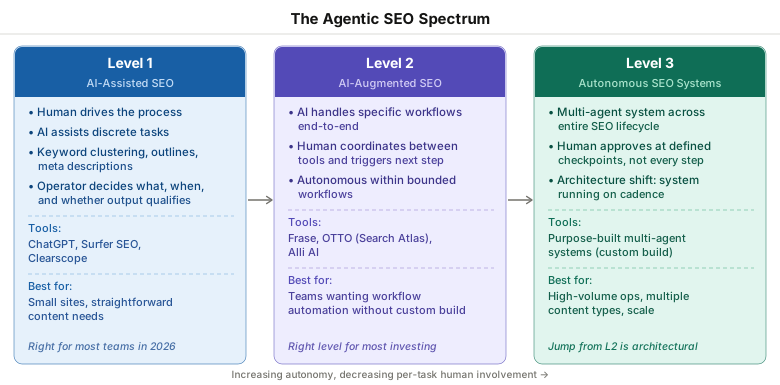
Not all agentic SEO is the same. The label covers a wide range of implementations, from a single AI writing assistant to a multi-agent system managing research, production, optimization, and monitoring in parallel. A useful way to evaluate any “agentic SEO” solution is to place it on a three-level spectrum.
Level 1: AI-Assisted SEO
A human drives the process. AI helps with discrete tasks: generating keyword clusters, drafting content outlines, suggesting meta descriptions. The operator decides what to work on, when to work on it, and whether the output is good enough. Tools like ChatGPT, Surfer SEO, and Clearscope operate here. This is where the vast majority of teams sit in 2026, and it works well for small sites with straightforward content needs.
Level 2: AI-Augmented SEO
AI handles specific workflows end-to-end, but a human coordinates between them. A platform might autonomously monitor your rankings, detect a drop, generate a content brief, and draft an updated version. The human still decides whether to publish, still bridges the gap between the keyword research tool and the content tool, still manually triggers the next step. Frase, OTTO by Search Atlas, and Alli AI operate here. They are genuinely useful platforms that automate real work. For many teams, this is the right level of investment.
Level 3: Autonomous SEO Systems
Multiple specialized agents work as a coordinated system across the entire SEO lifecycle. Research, brief generation, content production, quality review, image creation, publishing, performance monitoring, and iteration all happen through structured handoffs between agents, with human approval gates at defined checkpoints rather than at every step. No single tool covers this scope. It requires purpose-built agents that pass work to each other through a shared pipeline.
The jump from Level 2 to Level 3 is not incremental. It is an architectural shift from “better tools for my SEO team” to “an SEO system that runs on a defined cadence and surfaces results for human review.” Most organizations do not need Level 3. Those that do typically have high content velocity requirements, multiple content types, and enough complexity that manual coordination between tools becomes its own bottleneck.
What Level 3 Actually Looks Like in Production
We run a Level 3 system. It has been in production since early 2026, and the operational data is published across several pages on this site. Rather than describing what autonomous SEO could theoretically look like, here is what it actually looks like when you run it.
The system uses four core agents and two support agents covering the full content lifecycle. A research agent handles keyword tracking, competitive analysis, SERP monitoring, and content brief generation. A writing agent takes enriched briefs and produces full drafts calibrated to a specific voice profile, with built-in review processes that catch voice violations, grammar issues, and brief compliance problems before any human sees the work. An analytics agent monitors traffic, conversion rates, and engagement patterns to identify optimization opportunities. A distribution agent handles social amplification of published content.
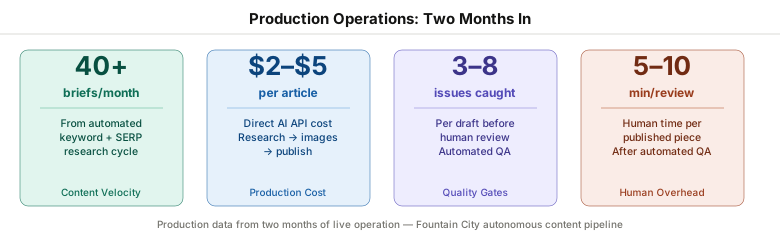
Each agent has a narrow job description and the specific tools it needs to do that job. The research agent, for example, runs scheduled workflows for keyword data collection, SERP analysis, GEO monitoring across nine AI search engines, and brief writing. It produces 40+ content briefs per month from this automated research cycle. We have written about how AI agent teams work in business operations in more detail elsewhere; the short version is that agent specialization beats general-purpose agents in every dimension that matters for production use.
The architecture changed meaningfully in our first months of operation. We initially ran everything on scheduled crons: specific times for research, writing, review, and publishing. That worked, but it created artificial delays. A brief that finished research at 10 AM would sit until the writing cron fired at 2 PM. We moved to a completion-triggered model where finishing one stage immediately triggers the next. A cron pulls work into the pipeline. Completion events push it through. An item can move from enriched brief to published WordPress draft in a single cascade, touching each quality gate along the way.
The handoff mechanism is intentionally low-tech: structured file drops between agent inboxes, with a shared pipeline tracker that records what stage every item is at. No message bus, no complex orchestration layer. Each agent reads its input, does its work, writes its output, and updates the tracker. The simplicity is the point. When something breaks, the debugging path is a text file and a log entry, not a distributed system trace.
The quality infrastructure matters more than the speed. Every draft goes through a self-review stage that checks against 25+ banned voice patterns, verifies source attribution, audits brief compliance, and flags anything that reads like generic AI output. That review catches issues in every draft before a human ever looks at it — voice drift, missing attribution, brief compliance gaps, anything that reads like generic AI output. Sebastian, our CEO, reviews the final output and approves for publication. His review typically takes five to ten minutes per piece because the automated review has already handled the mechanical quality work.
Once the infrastructure exists, the marginal cost to produce each additional article drops to a fraction of what a freelancer or agency charges. The full economics are detailed in our pipeline operations breakdown.

What Running Autonomous SEO for Two Months Has Taught Us
The system works. It also has real limitations that the vendor pitches in this space never mention.
Consistency compounds faster than quality
The research agent runs its keyword and competitive analysis on the same schedule every week. It does not skip a week because someone got pulled into a client project. It does not forget to check GEO citations because the team is busy with a product launch. It does not lose momentum during holidays, sick days, or hiring transitions. For SEO, where compounding effort over time drives most results, that consistency matters more than any individual piece of content being brilliant. Most SEO programs fail not because the strategy was wrong, but because execution was inconsistent.
We can produce and publish content faster than Google indexes it. That sounds like a good problem to have, but it creates a measurement lag that makes it hard to evaluate what is working in real time.
Human approval is the bottleneck — by design
The pipeline can produce a finished draft in hours. Getting it reviewed and approved depends on when the human reviewer has time. We could remove the human gate and publish autonomously, and the quality gates would catch most issues. We do not, because the issues they miss are the ones that damage credibility: an unverified claim, a tone-deaf opening, a placeholder that slipped through. The human review is not a limitation of the system. It is the system working as designed.
Agent coordination failures are real. Agents occasionally lose context, misinterpret a brief, or produce output that technically passes every quality gate but reads flat. These failures are different from tool failures. A tool either works or errors out. An agent can produce confidently wrong output that looks correct on the surface. We have had cases where the research stage found strong competitive data but the writing stage ignored it in favor of restating the brief’s thesis, or where a self-review flagged a voice issue and the fix introduced a different voice issue. Building detection mechanisms for these subtle failures is harder than building the agents themselves.
GEO monitoring changed our content strategy
Tracking citations across nine AI search engines revealed that AI platforms cite content differently than Google ranks it. Structured data, named frameworks, and specific operational numbers get picked up by AI engines at higher rates than narrative-driven content. This shifted how we structure articles — not what we write about, but how we format the arguments within them.
Voice calibration turns out to be a harder problem than content generation. Any capable language model can write a 3,000-word article. Getting it to write in a specific voice, consistently, across dozens of articles, without drifting into generic AI patterns is a separate engineering challenge. Our writing agent runs against a style guide with 25+ banned patterns and a set of preferred alternatives. The self-review stage checks every draft against those rules. Even with that infrastructure, we still catch voice drift on roughly one in five pieces. The calibration improves with each iteration, but it’s not a solved problem.
An autonomous system will also naturally reuse what worked before: the same proof points, the same frameworks, the same company references. Left unchecked, five articles in a row will cite the same two statistics and use the same credibility structure. We built a repertoire tracking system that flags repetition across the last several published pieces and pushes the writing agent to find fresh evidence. Maintaining variety across a high-volume pipeline is operational work that most autonomous content discussions ignore entirely.
Tool-Based vs. System-Based Agentic SEO: A Practical Comparison
The platforms in this space are genuinely useful. For most teams, a well-configured Level 2 platform is the right investment. The comparison below helps clarify where the approaches diverge and when the system-level approach makes sense.
| Capability | Frase | OTTO (Search Atlas) | Alli AI | System-Level (FC) |
|---|---|---|---|---|
| Automation Scope | Content research, creation, monitoring, and recovery | On-page optimization, technical fixes, content generation | Sitewide on-page and technical optimization | Full lifecycle: keyword research through publishing, monitoring, and iteration |
| Autonomy Level | Level 2 — autonomous within content workflows | Level 2 — autonomous for on-page and technical changes | Level 2 — autonomous for rule-based optimization | Level 3 — multi-agent system across all SEO functions |
| Multi-Agent | Single platform with specialized features | Single platform with automated task execution | Single platform with site-level automation | Five specialized agents with structured handoffs |
| Quality Gates | Content scoring and optimization suggestions | Automated implementation with rollback capability | Rule-based guardrails | Multi-stage automated review + human approval checkpoints |
| GEO Monitoring | Content Watchdog monitors 8 AI platforms | Limited AI search coverage | Not a primary feature | Tracks citations across 9 AI search engines weekly |
| Customization | Template-based with brand voice settings | Configuration-based automation rules | Site-level optimization rules | Fully custom agents built for your specific workflow |
| Pricing | $99–$999/mo | $99–$499/mo | $299–$999/mo | $2K–$6K/mo managed, incl. AI costs |
| Best For | Content teams wanting autonomous content research and recovery | Teams needing automated technical and on-page fixes | Multi-site SEO management with rule-based automation | Organizations needing full-lifecycle SEO automation with custom workflows |

Frase’s Content Watchdog feature is particularly strong for teams that already have a content operation and want autonomous monitoring and recovery. If your primary pain point is detecting ranking drops and generating recovery content, Frase at $99–$999/month solves that without the complexity of a custom system. Frase also recently integrated MCP (Model Context Protocol) for agent-to-tool communication, which indicates where the platform category is heading: tighter integration between specialized AI capabilities within a single product.
OTTO excels at automated technical fixes that would otherwise require developer time: schema markup deployment, canonical tag management, internal link optimization. For teams whose SEO bottleneck is implementation speed rather than content strategy, this solves a real problem. Alli AI’s strength is scaling on-page optimization across large multi-site portfolios, applying consistent rules across hundreds of pages without per-page configuration.
The system-level approach makes sense when no single platform covers your full workflow, when you need agents to pass context between stages rather than operating independently, or when your quality requirements demand multi-stage review processes that platform tools do not support. It also makes sense when your content needs to serve both traditional search and AI search engines simultaneously, requiring different structural optimizations that a single-purpose tool may not address. The cost reflects that difference. A custom build is an infrastructure investment, not a subscription. Organizations evaluating this path can start with agentic development consulting to scope whether the investment fits their operation.
Is Autonomous SEO Right for Your Business?
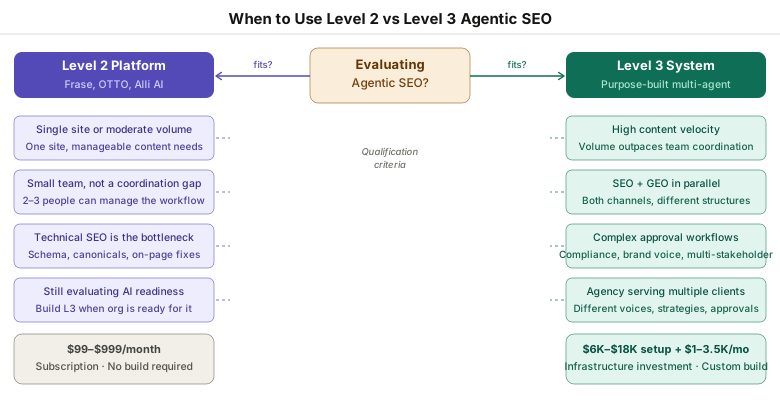
System-level agentic SEO is not for everyone. It is an investment in infrastructure, and like any infrastructure decision, the return depends on whether the scale of your operation justifies the build.
It makes sense when:
- You need to produce and manage content at a volume that outpaces your team’s coordination capacity. If the bottleneck is not writing speed but the overhead of managing research, drafts, reviews, and publishing across dozens of pieces per month, a system closes that gap.
- You need SEO and GEO optimization running in parallel. Traditional SERP ranking and AI search engine visibility require different structural approaches to the same content. A system that monitors both and adjusts accordingly saves the ongoing manual analysis.
- You have complex approval workflows. Multiple stakeholders reviewing content, compliance requirements, brand voice standards that vary by content type. Automated quality gates reduce the review burden without removing human judgment from the process.
- You are an agency offering content services to multiple clients. Each client has different voice profiles, keyword strategies, and approval processes. A multi-agent system can manage this complexity in a way that scaling a human team cannot match economically.
Tool-level (Level 2) is the better choice when:
- You manage a single site with moderate content needs. A well-configured Frase or OTTO subscription will cover most of what you need at a fraction of the cost.
- Your team is small enough that coordination is not a bottleneck. If two or three people can manage the full SEO workflow without dropping tasks, adding system-level automation creates complexity without proportional benefit.
- Your primary SEO challenge is technical, not content-driven. OTTO and Alli AI handle technical SEO automation well. A multi-agent content system solves a different problem.
- You are still evaluating your AI readiness. Building a Level 3 system before your organization is ready for autonomous operations creates expensive shelf-ware.
If you are exploring where SEO automation fits in your broader AI strategy, a useful starting point is understanding how to prioritize AI projects across your organization. SEO is one function. The same architectural decisions apply to any business process you want to automate.
The Market Context: Why This Matters Now
The urgency behind agentic SEO is not hype-driven. The search landscape has shifted structurally, and the data reflects it.
58.5% of Google searches now end without a click, according to SparkToro data cited by Siteimprove. Following the rollout of AI Overviews, 37 of the top 50 U.S. news sites lost referral traffic. These are not edge cases. They represent a structural change in how search delivers value. Optimizing only for traditional rankings means optimizing for a channel where the majority of queries no longer produce clicks.
Meanwhile, adoption is accelerating. Roughly 90% of marketing organizations already use some form of AI agent in their technology stack, according to BCG research cited by Frase. Organizations leading in agentic AI achieve five times the revenue gains of laggards. The gap between teams using AI for SEO and teams not using it is already wide. The gap between teams using tools and teams running autonomous systems is the next competitive divide.

That divide is about dual optimization: maintaining traditional search visibility while building presence in AI-generated answers. A system that monitors both channels and produces content structured for both audiences does work that a purely SERP-focused tool does not.
FAQ: Agentic SEO
What is agentic SEO?
Agentic SEO is the use of autonomous AI agents to handle SEO tasks across the full search lifecycle — from keyword research and content creation through optimization, publishing, and performance monitoring. Unlike using AI as a writing assistant, agentic SEO involves agents that plan, execute, and iterate on their own, with humans providing strategic direction and approval rather than step-by-step instructions. The system initiates work based on data triggers and schedules, not human prompts.
How is agentic SEO different from using AI writing tools?
AI writing tools handle one stage: content creation. Agentic SEO covers the full lifecycle. The difference is scope (single task vs. full workflow), coordination (one tool vs. multiple specialized agents), and autonomy (prompt-driven vs. goal-driven). A writing tool generates text when you ask it to. An agentic SEO system identifies what needs to be written, researches it, writes it, reviews it, and publishes it on a defined cadence.
What tools are used for agentic SEO?
At Level 2, several platforms handle specific SEO workflows autonomously:
- Frase: content creation and monitoring, $99-$999/mo
- OTTO by Search Atlas: technical and on-page automation, $99-$499/mo
- Alli AI: sitewide optimization, $299-$999/mo
- Surfer AI Agent: targeted workflow automation
At Level 3, purpose-built multi-agent systems combine keyword APIs, content generation models, quality review processes, and publishing integrations tailored to the specific operation.
Can small businesses use agentic SEO?
Yes, at Level 1 and Level 2. A small business with a single site and modest content needs can get meaningful results from AI-assisted keyword research and content creation tools. Level 3 autonomous systems make financial sense for organizations producing content at scale or managing multiple client accounts. The investment in custom infrastructure does not pay off until the volume justifies the build cost.
How does agentic SEO handle GEO (Generative Engine Optimization)?
GEO requires monitoring how AI search engines (Perplexity, Google AI Overviews, ChatGPT, Claude, and others) cite and reference your content, then structuring content to earn those citations. Agentic SEO systems track citation rates across multiple AI platforms, identify which content formats get cited most frequently, and adjust content structure accordingly. This dual optimization (traditional SERP + AI engine visibility) is one of the strongest practical arguments for autonomous SEO systems, since manual GEO monitoring across nine or more platforms is not sustainable. In practice, GEO optimization often means structural changes, adding named frameworks, explicit definitions, comparison tables, and FAQ sections that AI engines can extract cleanly, rather than changes to the underlying argument or topic selection.
What are the risks of autonomous SEO?
Quality control is the primary risk. AI-generated content can pass automated checks while still reading as generic or slightly off-brand. Multi-stage review processes and human approval gates mitigate this but do not eliminate it. Other risks include over-optimization (agents optimizing for metrics rather than reader value), hallucination in sourced claims (agents citing statistics they generated rather than found), and dependency on AI model quality (a model downgrade can affect output across the entire system).
How much does agentic SEO cost?
Costs vary by level:
- Tool-level (Level 2): $99-$999/month per platform, with budget options like Writesonic starting at $19/month
- System-level (Level 3): $1,000-$4,000/month for a custom build, covering ongoing management and AI API costs
- Per-article production (Level 3): $2-$5 in direct API costs
The economic argument for scale lives in that per-article number. Once the infrastructure exists, the marginal cost per piece drops dramatically.
For organizations evaluating whether an AI agent platform fits their operation, the qualification question is not “can we afford the system?” but “do we produce enough content for the system to pay for itself?”