AI Agent Deployment: The Operational Decision at Each Stage
Most teams running an AI agent pilot are being asked the same question right now: what do we build next? The published guidance is a stack of vendor maturity models that name the stages without naming the decisions inside them, and the team ends up debating models, prompts, and platforms while the pilot stalls.
A March 2026 Digital Applied survey found that 78% of surveyed enterprises had at least one agent pilot running and only 14% had scaled an agent to production-grade, organization-wide operation.
The same dataset surfaced something that reframes the problem: organizations with production-scale deployments did not have larger AI budgets than the organizations whose pilots stalled. They allocated the budget differently. Less on model selection and prompt engineering, more on evaluation infrastructure, monitoring tooling, and operational staffing. The teams that crossed into production reallocated. They did not outspend.
That finding changes what the deployment stages are for. Each stage has one operational decision that either reinforces the misallocation or breaks it. Get the decision right and the next stage gets cheaper. Get it wrong and you spend the next quarter rediscovering the same problems at higher volume.
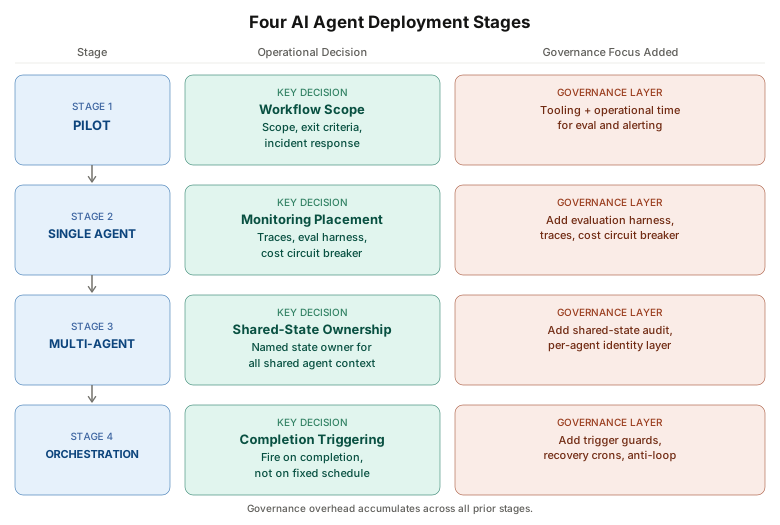
This article walks the four operational decisions: workflow scope at pilot, monitoring placement at single-agent production, shared-state ownership at multi-agent coordination, and completion triggers at autonomous orchestration. It also covers the shape of governance cost across the stages, when to stay one stage longer, and the mechanism we run at each stage in our own production pipeline.
The deployment problem is mostly an allocation problem

The Digital Applied survey is the first dataset we have seen that quantifies what production-scale AI agent teams did differently. It is not what most vendor decks would predict. The teams that made it across had comparable AI budgets to the teams that stalled. The difference was where the dollars went.
The blocking factors stalled organizations cited are mostly operational, not modeling. Output quality at volume, monitoring and observability, and organizational ownership are all the work that happens after a model is chosen, after a prompt is tuned, after the demo is approved. The single most-cited operational gap was monitoring and observability, named by 54% of stalled organizations as a blocking factor. That figure shows up again in the Dynatrace work cited later, and it is the one to anchor on: more than half of stalled deployments cannot see what their agents are doing.
The misallocation pattern is recognizable. A team finishes a successful pilot. The next quarter’s budget conversation centers on which model to upgrade to, which prompt strategy to standardize on, which platform to consolidate on. The evaluation harness, the monitoring layer, and the operational headcount are deferred to “after we get the architecture right.” By the time the architecture is settled, the budget for the deferred work is gone, and the agents are running in production without the operational scaffolding they need to scale.
Each of the four deployment stages has one decision that breaks this pattern. Each decision puts a load-bearing piece of operational scaffolding in place before the misallocation can compound. The decisions are not abstract. We have made each of them in our own production agent pipeline, watched the failure modes when we got each one wrong, and rebuilt accordingly.
Pilot stage: the decision is workflow scope
Most pilots are scoped for demo appeal. Someone picks a workflow that will produce a compelling video, the team ships an agent that handles the happy path, and the pilot is declared a success. Then production handoff begins, and integration complexity, the most-cited scaling gap in the Digital Applied data, surfaces all at once. The pilot was never scoped to the messy edges of the workflow it claimed to automate.
The pilot decision is workflow scope. Scope governs every downstream cost. Pick a workflow with a clean input boundary, a measurable success metric, and a defined incident response, and the next three stages inherit a workable foundation. Pick a workflow that looks good in a slide deck, and you are paying for that scope decision for a year.
The mechanism is to define exit criteria at pilot start, not at production handoff. Three concrete criteria, written down before the agent runs:
- Task volume threshold. What rate of work does the agent need to handle to be worth running in production? If the answer is “we will figure it out,” the pilot is not scoped.
- Quality measurement. What does a wrong answer look like, and how is it caught? The answer cannot be “the user will tell us.” Production agents cost money per run; you need a quality signal that does not depend on a human checking every output.
- Incident response. When the agent fails, what happens? Who gets paged? What runs in its place? “We will roll back” is not a plan if the agent is the only thing producing the work.
If the pilot cannot answer those three questions, the next stage is going to be operational firefighting. Worth pairing this stage with an honest AI readiness evaluation across data, governance, and culture before you commit to scaling the agent.

Single-agent production: the decision is monitoring placement
The pilot’s quality gate was a human in the loop. Production needs a different gate, and “we will add observability later” is the dominant failure pattern at this stage. A separate Dynatrace survey reports that a substantial share of leaders still rely on manual methods to monitor agent interactions — not an artifact of small deployments, but the operating reality of organizations that already have agents in production.
The single-agent production decision is monitoring placement. It has to be set before the agent goes live, not bolted on after the first incident. Three layers belong in place at deploy time:
- Traces. Every agent run produces a structured trace: inputs, tool calls, outputs, duration, cost. Without traces, you cannot diagnose a failure that did not raise an exception.
- Evaluation harness. A reference set of inputs and expected behaviors that runs before any change to the prompt, the model, or the tooling. Without an eval harness, every change is a guess.
- Cost circuit breaker. A spending threshold that alerts at one level and halts the agent at another. Agents fail in directions that traditional monitoring does not catch. They keep running, just badly and expensively. Our own production pipeline holds to a predictable daily AI infrastructure baseline only because the cost-defense layers were built before the agents were turned on, not after the first runaway.
The order matters. Traces are the diagnostic substrate. The evaluation harness sits on top, using traces to score behavior. The cost circuit breaker is the last-resort guard for the failure modes that the evaluation harness does not catch in time. Build them in that order, and the next stage, multi-agent coordination, has the diagnostic data it needs. Skip the order, and the next stage is debugged from log files. The per-layer architecture is in the cost circuit breaker article. It is the single piece of single-agent infrastructure we would not deploy without.

Multi-agent coordination: the decision is shared-state ownership
Multi-agent failures look different from single-agent failures. They are not crashes. They are agents stepping on each other’s work, losing track of items in flight, and producing results that contradict each other because each agent inferred the state of the system from a different source. The loss is operational drift rather than catastrophic failure, which is harder to detect.
The multi-agent decision is shared-state ownership. Most of these failures trace to a single cause: agents are assumed to be isolated when they are context-coupled. They touch the same work, but no one named the canonical source of truth.
The mechanism is to name one explicit state owner for each piece of shared context, and require every agent to read and write through it. A file, a table, a queue, a database row: the form does not matter. What matters is that there is one place where the system’s state lives, and no agent infers state from another agent’s output.
In our own pipeline, the canonical state lives in two structured files: one tracks the production status of every content item, and the other tracks topic-level metadata across the inventory. Every agent in the pipeline reads from those files at the start of its work and writes to them at the end. No agent guesses where the work is by reading another agent’s draft. That single architectural decision, a named state owner, eliminated an entire class of failure that had been showing up as “missing items” and “duplicate work” before we made it. The broader pipeline architecture is documented in detail, but the load-bearing decision at this stage is the state-ownership one, not the pipeline shape.

The reason this works: shared state is the point at which multi-agent systems either become a coordinated team or a set of agents producing parallel inconsistent outputs. The investment goes into one well-designed shared structure, not into many ad-hoc handoffs.
Autonomous orchestration: replace fixed schedules with completion triggers
By the time a system has multiple agents in production, the orchestration layer becomes the bottleneck. Variable-duration AI work breaks fixed-schedule orchestration. The symptom is items waiting between stages: a research stage finishes at 11:14am, but the writing stage runs at noon, so the item sits for 46 minutes for no operational reason. Multiply that across a dozen stages and the lag compounds.
The autonomous orchestration decision is to move from fixed schedules to completion triggers. Only the entry point of the pipeline runs on a clock. Every downstream stage fires when the previous stage signals completion. The plumbing is straightforward: a stage finishes, writes its output, and calls the next stage.
The numbers are concrete. Under our previous fixed-schedule design, a piece of work that could move through the pipeline in two to three hours was taking six to twelve. After replacing the fixed crons with completion triggers, the two-to-three-hour window held. The full design and the failure modes that drove it are in the completion-triggered orchestration piece.
One caveat that matters more than the orchestration win itself: completion triggers compound failures faster than fixed schedules do. A bug in stage three under fixed scheduling waits until tomorrow’s run to surface. A bug under completion triggering fires the next stage immediately, which fires the next, which can produce a cascade of bad outputs in minutes. So this stage’s decision has a dependent decision attached: pair completion triggers with anti-loop guards, retry caps, and the cost circuit breaker from the single-agent stage. The orchestration speed-up is real. So is the failure speed-up. Both have to be designed for at the same time.
The cost of governance is per-stage, and the curve is steeper than vendors imply
Governance dollars do not scale linearly across the four stages. They scale by what the stage requires you to monitor. A single-agent production system needs evaluation and alerting. A multi-agent system adds shared-state audit and per-agent identity. An autonomous orchestration system adds completion-trigger guards, recovery infrastructure, and an anti-loop layer.
The shape matters more than the dollar figure. Our own ranges are useful as a reference example, with the caveat that the reader’s numbers will differ based on agent count, workload, and model mix: across nine production agents and sixty-two scheduled jobs at the autonomous-orchestration stage, our daily AI infrastructure cost runs roughly $15-20. That is operational AI infrastructure cost. It is not the full cost of running the system. The curve shape matters more than the dollar figure.
What the curve looks like, by stage:
- Single-agent production. Evaluation harness, alerting, traces, cost circuit breaker. The cost is mostly tooling and the operational time to maintain reference sets and tune thresholds.
- Multi-agent coordination. Add shared-state audit and per-agent identity. The identity-visibility gap that surveys keep surfacing is theoretical until the multi-agent stage; once two agents share work, it becomes operational.
- Autonomous orchestration. Add completion-trigger guards, recovery crons, and per-stage cost limits. This is where agents can do the most damage in the shortest time, and the governance investment reflects that.
The allocation thesis applies again here. Governance dollars belong in evaluation, monitoring, and identity. They do not belong in picking a different model. The per-control breakdown is in the agent governance practitioners guide, mapped to the production stages.
Most teams should stay one stage longer than the vendor pitch implies
Vendors are selling autonomy. Most organizations are mid-curve and are being pushed forward before the decisions at their current stage are settled. The published survey data on enterprise-wide mature adoption is consistently a small minority of the field; the much larger group is the one that has shipped some agents but has not finished the operational scaffolding around them.
Staying longer at a stage is not stalling. It is finishing the operational decision at the current stage before adding the next layer of failure modes. A team that has not settled monitoring placement at single-agent production will find the multi-agent stage harder, not easier. A team that has not named shared-state ownership in multi-agent will find autonomous orchestration produces faster cascades, not faster work.
The question worth asking at the end of a quarter is not “are we ready for the next stage?” It is “have we settled the operational decision at the current stage?” If the answer is no, the next stage is going to be debugged on top of an unsettled one, and the cost of that compound failure shows up later as the kind of stall that the survey data is measuring.
This is also where the conceptual maturity layer lives. The five levels of AI maturity name what each level looks like. The four operational decisions in this article name what to build at each level so the next one becomes possible. The two layers are companions, not duplicates. The decisions in this article are the work that has to happen for an organization to actually move up the maturity curve, rather than describing where they currently sit on it.

Where to go from here
If you have a working pilot, the next operational decision is not which model to upgrade to. It is which workflow to harden, where to place monitoring before the agent goes live, who owns shared state when two agents touch the same work, and how to replace fixed schedules with completion triggers when orchestration starts to drag. Those four decisions, made deliberately, are what the production-scale teams in the Digital Applied survey did with their reallocated budgets.
If you want a partner who has already made each decision in a running production system and can build the infrastructure for your team, our managed autonomous AI agents service runs the full operational stack: evaluation, monitoring, shared-state, orchestration, and governance, at a published price. The decisions are the same whether we run them or you do. The article above is the framework. The service is the implementation.
Frequently Asked Questions
How do I know when my AI agent pilot is ready to move to production?
The pilot is ready when three exit criteria are met: the agent reliably handles a defined task volume, there is a quality measurement that does not depend on a human reviewing every output, and there is a defined incident response when the agent fails. If any of those is missing, production handoff will surface the gap as an integration failure rather than a pilot finding. Production-scale teams in the Digital Applied data wrote those criteria at pilot start, not at handoff.
What’s the operational difference between single-agent and multi-agent deployment?
A single agent fails in directions that traditional monitoring catches: error rates, latency, output quality. Multi-agent systems fail through coordination drift. Agents lose track of each other’s work, step on each other, or produce inconsistent outputs because each inferred the state of the system differently. The operational shift is from instrumenting the agent to instrumenting the shared state the agents read and write through. If you cannot point to one canonical state owner that every agent uses, you are running multiple agents, not a multi-agent system.
What does AI agent governance actually cost at each stage?
The shape is more useful than the figure. At single-agent production, governance is tooling and operational time for evaluation and alerting. At multi-agent it adds shared-state audit and per-agent identity — closing the visibility and containment gap that Cloud Security Alliance research has documented across organizations running agents. At autonomous orchestration it adds completion-trigger guards and recovery infrastructure. The curve, with costs concentrated in evaluation, monitoring, and identity rather than in model and prompt, is the part that generalizes across teams.
How do I scale AI agents without ballooning ongoing costs?
Build the cost defense before the agents go live, not after the first runaway. Daily and per-job spending limits, alerting thresholds set lower than halt thresholds, and an evaluation harness that catches behavioral drift before it shows up as a budget overrun. Cloud Security Alliance research found that 92% of organizations lack full visibility into AI agent identities, and most doubt they could detect or contain a compromised agent — that visibility deficit is what makes runaway costs expensive to catch later. Build identity, audit, and cost-defense into the deploy step. Our daily AI infrastructure cost has stayed in a predictable range as we have added agents and jobs because the limits were in place before the volume was.
When should I add a recovery or anti-loop layer to my agent system?
At the autonomous orchestration stage, before the first completion-triggered run. Completion triggers move work faster, and they also propagate failures faster. A recovery layer of retry caps, anti-loop guards, and cost ceilings tied to the per-stage budget is the dependent decision that has to ship with completion triggering, not after it.
Why do most AI agent pilots never reach production?
The Digital Applied survey found that pilots stall within months on average. The blocking factors named (integration complexity, output quality at volume, monitoring deficit, organizational ownership, domain training data) are consistent with pilots scoped for demo appeal rather than for a workflow with measurable success criteria, scaled into production without monitoring placement decided, and operated without a clear shared-state owner. Each of those is the absence of a decision at the corresponding stage. The cumulative result is the pre-production failure rate that maturity-model coverage keeps surfacing.