Agent Governance in Practice: A Practitioner’s Guide to Securing Production AI Agents
Agent Governance in Practice: Why April 2026 Changed the Conversation
If you’re running autonomous AI agents in production, governance just went from “we should probably think about that” to “we need this implemented before August.” Three things converged in the span of a single week that made the shift unavoidable.
In this article:
- What the OWASP Agentic Top 10 risks actually mean for a company running fewer than 50 agents, with practical controls for each
- A complete mapping of OWASP risks to Microsoft’s newly open-sourced Agent Governance Toolkit
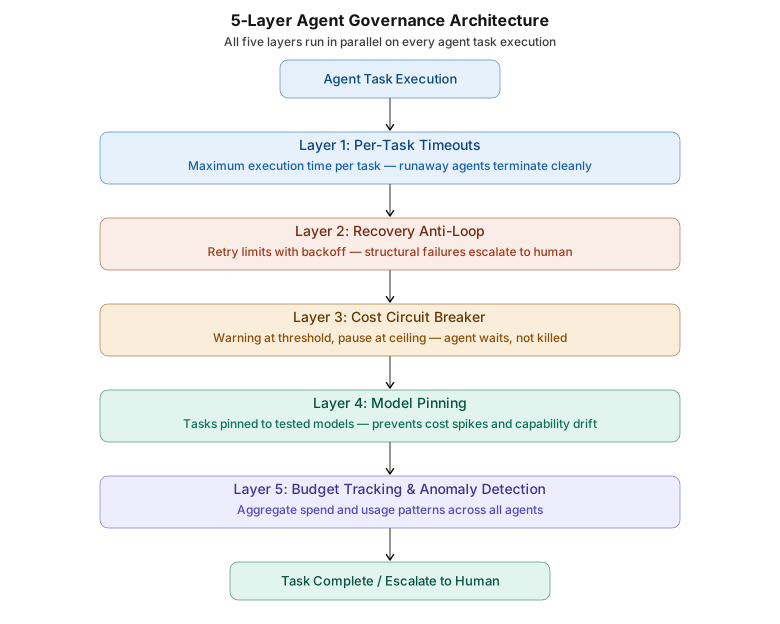
- What production agent governance looks like in a real multi-agent system — our 5-layer architecture (per-task timeouts → recovery anti-loop → cost circuit breaker → model pinning → budget tracking), with specific implementation details
- A 90-day implementation plan designed to get you governed before the EU AI Act high-risk deadline in August 2026
- Honest lessons from getting governance wrong before getting it right
On April 2, Microsoft open-sourced the Agent Governance Toolkit, a seven-package runtime security framework that maps to all 10 OWASP agentic AI risks with sub-millisecond enforcement. This wasn’t a whitepaper or a press release about future plans. It was working code, available in Python, TypeScript, Rust, Go, and .NET, designed to slot into existing agent frameworks like LangChain, CrewAI, and AutoGen.
The same week, the Cloud Security Alliance published a governance gap report with numbers that should make anyone running agents uncomfortable: 92% of organizations lack full visibility into their AI agent identities; 95% doubt they could detect or contain a compromised agent; and security researchers documented approximately 8,000 MCP servers exposed on the public internet without authentication.
And the regulatory clock is now audible. The EU AI Act’s high-risk obligations take effect in August 2026. Colorado’s AI Act hits in June. NIST launched its AI Agent Standards Initiative in February, though substantive deliverables aren’t expected until late 2026.
The gap between “agents are running” and “agents are governed” has been growing for over a year. Arkose Labs surveyed 300 enterprise leaders and found 97% expect a material AI-agent-driven security or fraud incident within the next 12 months. Meanwhile, only 6% of security budgets are allocated to AI-agent risk. That math doesn’t work.
What the OWASP Agentic Top 10 Actually Means for Your Agents
The OWASP Top 10 for Agentic Applications, published in December 2025 with input from over 100 industry experts, is the first formal risk taxonomy for autonomous AI systems. It’s useful as a reference, but most coverage just lists the risks without showing what “addressed” looks like compared to “unaddressed.” Here’s the practical version.
| OWASP Risk | What It Means (Plain Language) | Practical Control (Mid-Market) | MS Toolkit Package |
|---|---|---|---|
| 1. Excessive Agency | Agent has more permissions than it needs. A content agent that can also delete databases. | Least-privilege tool access. Each agent gets only the tools its job requires. Review permissions quarterly. | Agent OS, Agent Auth |
| 2. Uncontrolled Autonomy | Agent can run indefinitely without human checkpoints. No kill switch, no time limits. | Per-task timeouts. Budget ceilings per execution. Human approval gates for high-impact actions. | Agent Runtime |
| 3. Identity & Access Abuse | Agents using shared credentials or human accounts. No way to tell which agent did what. | Unique identity per agent. Separate API keys, separate log streams. Never share credentials between agents. | Agent Identity, Agent Mesh |
| 4. Goal/Instruction Hijacking | External input manipulates the agent into doing something outside its intended purpose. | Input validation on all external data. Sandbox untrusted inputs. System prompts that resist override attempts. | Agent OS |
| 5. Memory Poisoning | Corrupted data in the agent’s memory or context changes its future behavior in unintended ways. | Versioned memory with rollback capability. Integrity checks on persistent state. Regular memory audits. | Agent OS, Agent SRE |
| 6. Tool/API Misuse | Agent calls tools with unintended parameters or in unintended sequences. Uses a delete endpoint when it should use update. | Schema-validated tool calls. Rate limiting per tool. Allowlists for destructive operations. Log every external API call. | Agent Runtime, Agent Auth |
| 7. Cascading Failures | One agent fails, triggering failures across connected agents. A research agent crashes, the writing agent consumes bad data, the publishing agent publishes garbage. | Circuit breakers between agent stages. Each agent validates its inputs independently. Retry limits with backoff. Doom spiral protection. | Agent SRE |
| 8. Rogue Agents | An agent operates outside its defined boundaries, either through drift or compromise. | Behavioral monitoring against baseline. Anomaly alerts. Hard boundaries on scope (file paths, network access, API endpoints). | Agent Compliance, Agent SRE |
| 9. Data Leakage | Agent exposes sensitive information through its outputs, logs, or tool calls. | Output filtering for PII/secrets. Credential isolation (agents never see raw secrets). Log redaction rules. | Agent Compliance, Agent OS |
| 10. Inadequate Audit Trail | No record of what the agent did, when, or why. When something goes wrong, there’s nothing to investigate. | Structured logging of every decision, tool call, and output. Immutable audit logs. Retention policies aligned with regulatory requirements. | Agent Compliance |
The Microsoft toolkit column matters because it’s the first time these risks have been mapped to specific, deployable open-source packages. Before April 2, addressing OWASP’s list meant building everything yourself. Now there’s a reference implementation. The toolkit delivers governance enforcement at sub-millisecond latency (<0.1ms p99), which addresses the most common objection to runtime governance: “it’ll slow my agents down.”

What Production Agent Governance Actually Looks Like
We manage governance infrastructure across 9 specialized AI agents, each with its own permissions, identity, cost ceiling, and execution limits, handling tasks from research and content creation to analytics and site management. Governance didn’t arrive as a planned initiative. The architecture that emerged from those failures has five distinct layers, each solving a specific class of problem that earlier layers didn’t catch. They run in parallel, not in sequence. Every agent execution passes through all five.
Layer 1: Per-Task Timeouts
Every agent task has a maximum execution time. In our system, that’s runTimeoutSeconds: 600 in openclaw.json — every cron is hard-killed at 10 minutes. Research tasks, writing tasks, and pipeline stages all share this ceiling, enforced at the orchestration layer, not by the agent itself. An agent can’t extend its own deadline. If it hits the limit, the task fails cleanly and the orchestrator logs the timeout with full context.
This is the simplest governance layer and the one with the highest ROI. A single runaway task can consume hundreds of dollars in API calls if left unchecked. The timeout is the floor — every other governance layer builds on the assumption that unbounded execution is already off the table.
Layer 2: Recovery Anti-Loop (Doom Spiral Protection)
When an agent fails, the natural instinct of any retry system is to try again. The problem: some failures are self-reinforcing. An agent fails, gets retried, fails the same way, gets retried, and each retry consumes the same resources as the original attempt. We call this a doom spiral.
Our anti-loop system runs pipeline-recovery.py every 30 minutes during office hours (8 AM–6 PM PT weekdays). Any item stuck for more than 1 hour triggers a recovery attempt. After 2 failed recovery attempts, the circuit trips: a flag file is written, a Discord alert fires to the ops channel, and the recovery script self-disables until manually reset. The circuit breaker came directly from a real incident on April 4, 2026 — a doom spiral in the AM/PM pipeline split that consumed 472K tokens and $2.78 before it was caught. That one incident justified the entire anti-loop layer.
The system differentiates between transient failures (API timeout, rate limit) and structural failures (bad input data, missing dependencies). Transient failures get retries with exponential backoff. Structural failures get logged, flagged for human review, and the agent moves on to the next task.
Layer 3: Cost Circuit Breaker
Every agent execution has a cost ceiling. cost-monitor.py runs every 30 minutes against three thresholds:
- DAILY_WARN at $50: triggers a Discord alert
- DAILY_HALT at $100: disables all crons
- MONTHLY_WARN at $600: approximately our $20/day run rate across 30 days
These numbers are already published in our OpenClaw security best practices guide, which covers the spending circuit breaker implementation in detail.
The design philosophy is suspend-and-escalate: execution doesn’t just trigger an alert — when the hard ceiling is hit, crons disable and a human decision is required before resumption. Killing an agent mid-task can leave systems in an inconsistent state. A content agent terminated while updating a WordPress draft might leave a half-written post visible on the site. Suspending until a human reviews is safer than an automatic kill.
Layer 4: Model Pinning
Each agent task is pinned to a specific AI model. In our pipeline, research tasks run on GLM-5, writing and review stages run on Opus, and art direction runs on Sonnet. The assignment is deterministic — it’s not left to the agent to choose. When the GLM-5.1 migration landed in April 2026, 27 crons had to be explicitly re-pinned. That’s the right behavior: a model change is a deliberate decision, not an automatic propagation.
Model pinning prevents two failure modes. The first is cost blowout — a task accidentally running on the most expensive model. The second is quality drift — a task running on a model that wasn’t tested for that job type. Both produce silent failures: the system appears to work, but the output degrades in ways that take time to surface.
Layer 5: Budget Tracking and Anomaly Detection
The final layer watches aggregate patterns across all agents over time. Individual task governance handles the micro level. Budget tracking handles the macro: two scripts run in parallel. cost-monitor.py monitors daily USD spend. zai-quota-monitor.py tracks a 5-hour burst window and weekly token cap, warning at 70% utilization and alerting at critical/exhausted states. Both surface in the ops dashboard with a quota-burn widget. Discord alerts land in the ops channel.
These five layers map directly to several OWASP risks. Per-task timeouts address Uncontrolled Autonomy (risk #2). The anti-loop system addresses Cascading Failures (#7). Cost circuit breakers address Excessive Agency (#1) and Tool Misuse (#6). Model pinning addresses Rogue Agents (#8). Budget tracking addresses Inadequate Audit Trail (#10). No single layer covers everything, and they weren’t designed to. Each one was added to solve a specific problem that the existing layers didn’t catch.
Mapping Production Governance to Microsoft’s Formal Framework
When Microsoft released the Agent Governance Toolkit, the categories mapped directly to patterns we’d built independently.
| MS Toolkit Package | What It Does | Our Equivalent | Gap/Notes |
|---|---|---|---|
| Agent OS | Policy engine — enforces governance rules at runtime | Cost circuit breaker + model pinning | Our policies are config-driven, not a formal policy language. Toolkit’s approach is more portable. |
| Agent Runtime | Execution rings — sandboxed execution with resource limits | Per-task timeouts + recovery anti-loops | Similar intent, different implementation. Toolkit uses formal execution rings; we use orchestrator-enforced limits. |
| Agent SRE | Reliability engineering — health monitoring, anomaly detection | Budget tracking + anomaly detection | Toolkit’s monitoring is more formalized. Our anomaly detection is effective but custom-built. |
| Agent Mesh | Agent identity and inter-agent communication governance | Agent-specific permissions + isolated workspaces | We have isolation but not a formal mesh identity system. This is a gap worth addressing. |
| Agent Compliance | Audit trails, regulatory reporting, data retention | Structured logging + execution logs | Toolkit adds formal compliance reporting. Our logs are detailed but not formatted for regulatory submission. |
| Agent Identity | Unique, verifiable identity per agent | Separate credentials per agent | Basic implementation. Toolkit offers cryptographic verification we don’t have yet. |
| Agent Auth | Fine-grained authorization for agent actions | Tool allowlists + action-level permissions | Functional overlap. Toolkit’s approach is more granular and standardized. |
The point of this mapping isn’t to claim our system is equivalent to Microsoft’s toolkit. It isn’t. The toolkit is more formalized, more portable, and designed for broader adoption. The point is that the governance patterns Microsoft codified are the same patterns practitioners discover independently when they run agents long enough for things to go wrong. If you’re building governance from scratch today, the toolkit gives you a significant head start. If you’ve already built governance, the toolkit tells you where your gaps are.


The 90-Day Governance Implementation Plan (Before August 2026)
The EU AI Act’s high-risk obligations take effect in August 2026. Colorado’s AI Act arrives even sooner, in June. If you’re running agents that make decisions affecting people (hiring, lending, insurance, medical triage), you likely fall under high-risk classification. Even if you don’t, the regulatory direction is clear: agent governance is moving from voluntary to mandatory.
This plan assumes a mid-market company running 5-15 agents. Adjust scope based on your situation, but don’t adjust the timeline. The deadlines are fixed.
Weeks 1-2: Audit
Start by answering three questions for every agent in your system:
- What does this agent have access to? (Tools, APIs, databases, file systems, credentials)
- What can this agent do that would be hard to undo? (Deletions, external communications, financial transactions, public publishing)
- What happens if this agent runs for 24 hours uninterrupted? (Cost projection, potential damage radius)
Map each answer to the OWASP Top 10 risks in the table above. Your top 3 risks will become obvious. For most companies running fewer than 50 agents, Uncontrolled Autonomy (#2), Cascading Failures (#7), and Inadequate Audit Trail (#10) are the ones that matter first.

Weeks 3-6: Implement Core Controls
Start with the governance layers that have the highest ROI and lowest friction:
- Timeouts first. Every agent task gets a maximum execution time. This is a config change, not an architecture change. It prevents runaway costs and addresses Uncontrolled Autonomy immediately.
- Cost ceilings second. Set a daily and per-task spending limit. Start generous and tighten over time based on observed patterns. Wire up alerts so a human gets notified before the ceiling is hit.
- Structured logging third. Every agent decision, tool call, and output goes to a structured log. This doesn’t require fancy infrastructure; a well-organized log file per agent per day is a starting point. You need this for regulatory compliance and for debugging when something goes wrong.
- Separate identities. Every agent gets its own API keys, its own credential set, its own log stream. No sharing. This is tedious to set up and invaluable when you need to investigate an incident.
Weeks 7-12: Harden and Verify
- Add circuit breakers between agent stages. If your agents hand work to each other (agent A produces input for agent B), add validation at each handoff. Agent B should verify its inputs before acting on them, regardless of trust in agent A.
- Implement anomaly detection. This doesn’t require machine learning. Start with simple threshold alerts: if daily costs exceed 2x the 7-day average, if any single task exceeds 3x the median execution time, if tool call patterns change significantly. These rules catch most problems.
- Run a red-team exercise. Pick your three most critical agents. Try to make them do something outside their intended scope. Feed them adversarial inputs. Test whether your governance layers actually catch the problems they’re designed to catch.
- Document your governance posture. The EU AI Act requires demonstrable governance for high-risk systems. Even if you’re not classified as high-risk today, documentation makes compliance straightforward when regulations expand.
Minimum Viable Governance
You don’t need all 10 OWASP risks addressed on day one. Minimum viable governance for a company running fewer than 10 agents is:
- Per-task timeouts on every agent (addresses Uncontrolled Autonomy)
- Cost ceilings with human alerts (addresses Excessive Agency)
- Structured logging of all tool calls (addresses Inadequate Audit Trail)
- Separate credentials per agent (addresses Identity & Access Abuse)
Four controls. You can implement all four in a week if your agent framework supports configuration-level changes. This won’t make you fully governed, but it eliminates the scenarios that cause the most damage: runaway execution, runaway costs, untraceable actions, and shared-credential incidents.
What We Got Wrong (And What It Taught Us)
Governance for us started as damage control. Each layer below came from a specific incident.

On April 4, 2026, a doom spiral in the pipeline consumed 472K tokens and $2.78 before anyone caught it. The cause: AM/PM cycle logic combined with an evening filter to reject every new topic after 5 PM, which triggered a retrigger loop. Each retry was legitimate by itself; together they were catastrophic. The circuit breaker on the recovery script — the two-attempt limit, office-hours guard, self-disable behavior — came directly from that incident. The anti-loop exists because we’d already seen the alternative.
A week earlier, on March 25, the gateway heap exhausted memory — not a rogue agent, just accumulated session memory from 2.5 days of uptime, 135 Discord reconnects, and one large session. V8 hit the 2 GB default limit, GC thrashed the event loop, and the cron scheduler died silently. The process appeared alive to systemd for 21 hours while no jobs ran. The fix: a hard 1.5 GB heap cap that forces a clean crash and systemd auto-restart, plus a daily 4 AM PT scheduled restart to prevent slow accumulation. The lesson isn’t about agents — it’s that governance has to include the infrastructure the agents run on, not just the agents themselves.
The more instructive failures happened after governance was in place. When we tested GLM-5-Turbo for the dedup-check stage to reduce cost, the model missed 52% of items and produced 4 false positives. Opus caught all 21 items with zero false positives. Every step ran without errors. The output was unusable anyway. Model pinning recognizes that model accuracy is load-bearing at certain stages. “Cheaper” and “equivalent” aren’t the same thing.
The most useful meta-governance lesson came from a stale pricing table. Our ops dashboard had Opus 4-6 priced at numbers from an earlier model version for months, inflating cost estimates roughly threefold before anyone noticed. The governance system was working correctly. The config it consulted was wrong. If you’re building governance, build governance-of-the-governance: periodic audits of the config files, threshold values, and reference data your governance layers depend on. They drift too.
The Arkose Labs report found that 87% of enterprise leaders agree AI agents with legitimate credentials pose a greater insider threat than human employees. That framing matches our experience. The dangerous failure mode is an agent with perfectly valid permissions doing the wrong thing in good faith, at machine speed, for longer than anyone notices.
The other lesson: governance has a cost. Every layer adds latency, complexity, and operational overhead. Microsoft’s toolkit helps with the latency concern (sub-millisecond enforcement), but the complexity and operational overhead are real regardless of tooling. Budget for governance as a first-class system concern, not an afterthought. The AI agent market is projected to reach $10.91 billion with 46% CAGR in 2026. Governance complexity is only going to increase.
Runtime Controls Are the New Encryption
In February 2026, CodeWall’s autonomous offensive AI agent walked through 22 unauthenticated API endpoints at McKinsey, pivoted via SQL injection, and reached full read-write access to the production database backing Lilli, the firm’s internal assistant used by tens of thousands of consultants. The agent was inside in under two hours, with no human operator and no stolen credentials. It exfiltrated 46.5 million plaintext chat messages, 728,000 confidential files, 57,000 user accounts, and 3.68 million retrieval-augmented-generation document chunks. The detail that reframes the incident is the last one: it also found 95 system prompts that shaped Lilli’s behavior across the firm, all of which were fully writeable.
Wharton’s Accountable AI Lab, in the first academic treatment of the breach, described what writeable prompts mean in practice: “With one carefully crafted database update, a malicious actor could quietly modify Lilli’s core behavior. Consultants would continue using and trusting the system without realizing that its mind had been altered. This goes beyond a conventional data breach. It instead represents a kind of supply-chain compromise at the level of reasoning itself.” You don’t need to steal the data to destroy the company. You just need to change how its AI reasons.

The Encryption Analogy
There was a time when encryption was treated as optional. Developers saw it as performance overhead. Operations teams saw it as deployment friction. Security teams lost the argument repeatedly until the breaches stacked up high enough to change the default. Somewhere between the early 2010s and the mid-2010s, the industry quietly settled on a rule: if data moves, it’s encrypted. If data sits at rest, it’s encrypted. Exceptions are the thing that needs justification, not the other way around.
Agent security is moving through the same transition, compressed into a shorter window. Static security (authentication at the perimeter, encryption on the wire, RBAC at the API layer) was designed to protect data. It was not designed to protect decisions. An agent that has legitimately authenticated, fetched encrypted data correctly, and passed all access-control checks can still act outside its intended scope. The data was safe. The reasoning wasn’t.
Ben Kliger, co-founder and CEO of Zenity, put it plainly in CSA’s April 2026 enterprise agent survey: “The real question is: why did the agent do that?” His point: legacy security answers what happened after the fact. Runtime controls answer why, while the agent is still running, by bounding what “why” is allowed to be. The same survey found that 53% of organizations have already had AI agents exceed their intended permissions, and only 8% said their agents never exceed permissions. Inverted, 92% of organizations running agents have already watched them step outside the lines at least occasionally. Only 16% reported high confidence in detecting agent-specific threats.
Stanford’s AI Index 2026 added the capability side of the same trendline. The Cybench unguided cybersecurity solve rate jumped from 15% to 93% in a single year, and 62% of organizations cite security and governance as the primary barrier to scaling agentic AI, a 24-point margin over any other blocker. Kiteworks’ summary of that report lands on the same conclusion the practitioners reach: “Model-level guardrails are not sufficient as security controls. Governance must happen at the data layer, enforced independently of the model, the prompt, and the agent framework.”
Read together, Wharton, CSA, and Stanford are all saying the same thing in different vocabulary. The threat vector is reasoning, not data. The control surface has to live where the reasoning happens, at runtime, outside of anything the agent can rewrite. Runtime controls are the new encryption: the thing you assume is in place before anyone ships.
Four Runtime Primitives and What They Actually Protect Against
The five-layer architecture described above maps cleanly onto four primitives, each bounding a different dimension of what an agent can do. Naming them gives a vendor conversation a shape: when a platform says it has “runtime security,” you can ask which of the four it actually enforces.
Time bounds. Cap how long any single agent run can execute. This prevents runaway loops and the class of attack the Lilli incident exemplifies, where an autonomous adversary’s value compounds with uninterrupted runtime. Two hours of unbounded access is what CodeWall needed. A 10-minute per-task timeout (runTimeoutSeconds: 600 in our case) ends the attack before it finishes enumeration. Time bounds address OWASP’s Uncontrolled Autonomy directly.
Resource bounds. Cap how much money, compute, tokens, or API calls a run can consume before it’s halted. Our cost circuit breaker uses $50/day warning, $100/day hard halt, and $600/month warning, because those ceilings keep a single runaway run from turning into a five-figure invoice. Resource bounds are what makes economic-DoS attacks against agent systems unprofitable and what prevents a single bug from becoming a finance incident. They address Excessive Agency and Tool/API Misuse.
Behavior bounds. Constrain which model runs each task, which prompts are writeable, and how often retries are allowed. This is the primitive the Lilli breach most directly points at. If Lilli’s 95 system prompts had been read-only at runtime, enforced outside the database layer, a write to the prompt table would not have silently changed behavior. Model pinning and recovery anti-loop thresholds fall here. Behavior bounds address Rogue Agents and Memory Poisoning, and they’re the hardest primitive to retrofit, because most agent frameworks treat prompts and model selection as configuration, not as controlled surfaces.
Action bounds. Restrict what external systems the agent can touch, with what credentials, through which tools. Scope-limited API keys, tool allowlists, and completion-triggered orchestration (agents hand off to other agents, rather than looping freely) sit here. Action bounds address the CSA 53%, the scope violations organizations are already seeing. They’re also what distinguishes an agent that can only read from your CRM from one that can also delete accounts in it.
Every control a vendor might call “runtime security” fits into one of these four buckets. Most platforms do one or two well. A complete runtime posture requires all four, enforced by the orchestration layer rather than by the agent itself. The practical question for a buyer is not “do you have runtime security” but “which primitive, and what’s the threshold.”
Mapping the Research to the Controls
It helps to see the correspondence laid out.
| Attack Surface | Source Finding | Runtime Primitive |
|---|---|---|
| Unbounded execution time | CodeWall reached full DB access in <2 hours (Wharton, April 2026) | Time bounds |
| Runaway resource consumption | 62% cite security/governance as #1 scaling barrier (Stanford AI Index 2026, via Kiteworks) | Resource bounds |
| Reasoning-layer compromise | 95 writeable system prompts at Lilli; “supply-chain compromise at the level of reasoning itself” (Wharton) | Behavior bounds |
| Scope violation and tool misuse | 53% of orgs had agents exceed permissions; only 8% never (CSA/Zenity, 2026) | Action bounds |
| Detection confidence | Only 16% report high confidence detecting agent-specific threats; 44% low or no confidence (CSA/Zenity) | Audit trail layer (complementary, not a primitive) |
The audit row is in the table but flagged as complementary. Audit logs don’t prevent an attack; they explain one after it happens. The four primitives prevent. Both are necessary; they solve different problems.
What Runtime Controls Don’t Protect Against
Named patterns earn their keep only if they also name their limits. Runtime controls are the load-bearing layer for preventing agent-in-motion damage. They don’t cover everything.
They don’t protect against compromise of the upstream model provider. If OpenAI, Anthropic, or Google ship a backdoored model or a silent behavior change, runtime bounds on our side limit the blast radius but don’t catch the root cause. That’s why model pinning matters as a deliberate, audited decision rather than a floating dependency.
They don’t protect against physical infrastructure compromise. If an attacker has root on the orchestrator, the runtime controls are just files to be edited. That’s a hosting and access-management problem, outside the agent security model.
They don’t protect against malicious insiders with legitimate administrative access. A person who can legitimately modify the threshold values (raise the $100/day halt to $10,000, disable the timeout, un-pin the model) can disarm the runtime controls from the inside. Audit trails make that detectable after the fact. They don’t prevent it.
They don’t replace the rest of the governance program. OWASP’s 10 risks cover more than runtime posture. Memory poisoning, data leakage, inadequate audit trail, and identity abuse each require their own controls. Runtime primitives are one pillar of a broader governance posture, not the whole building.
Five Questions for Evaluating an Agent Vendor
If you’re buying or building on someone else’s agent platform, the runtime posture reduces to five concrete questions. Each maps to one of the four primitives, plus one question on the audit layer. None of them should produce hesitation from a vendor that has actually built for production.

- Time bounds. What happens if one of your agents runs longer than X minutes? Where is that limit enforced? By the agent, or outside it? Can the agent extend its own deadline?
- Resource bounds. What’s the hard cost ceiling for a single agent run, and for the account daily? When that ceiling is hit, does execution continue, alert only, or halt and require human acknowledgment before resuming?
- Behavior bounds. Are system prompts writeable at runtime, or are they immutable after deployment? If writeable, who can write them, and is every write audited? Can the agent change its own model selection mid-run?
- Action bounds. What external systems can each agent touch, with what credentials? How are tool allowlists defined, and can the agent add tools to its own allowlist? If an agent is compromised, what’s the blast radius of what it can reach?
- Audit trail. If an incident happens, what’s the artifact you’d hand to a security investigator? How long is it retained, and is it tamper-evident?
The questions are deliberately mechanical. A vendor selling “runtime security” without numeric answers to the first four is selling a marketing term, not a control surface. A vendor who can answer all five is running the same discipline that kept CodeWall from being repeatable against a governed system. Static security taught the industry that encryption is the default, not a feature. Runtime controls are arriving at the same conclusion on a tighter deadline.
FAQ
How much does AI agent governance cost to implement?
The core controls (timeouts, cost ceilings, structured logging, separate credentials) are configuration-level changes with near-zero marginal cost if your agent framework supports them. The operational cost is in monitoring and responding to alerts. For a mid-market company running 5-15 agents, expect 2-5 hours per week of governance-related operational work (reviewing alerts, investigating anomalies, updating policies). The alternative, running agents without governance, is more expensive in expectation. One undetected runaway incident can cost more than a year of governance overhead.
Do I need Microsoft’s Agent Governance Toolkit, or can I build governance myself?
You can build governance yourself. We did, and many of our patterns predate the toolkit. The toolkit’s value is that it’s standardized, open-source, and maintained by Microsoft. If you’re starting from scratch, the toolkit saves you months of custom development. If you’ve already built governance, the toolkit is useful as a benchmark to identify gaps in your implementation, particularly around formal identity management and compliance reporting.
What’s the minimum viable governance for a company running fewer than 10 agents?
Four controls: per-task timeouts, cost ceilings with human alerts, structured logging of all tool calls, and separate credentials per agent. These can be implemented in about a week and address the four highest-impact risks (Uncontrolled Autonomy, Excessive Agency, Inadequate Audit Trail, and Identity Abuse). Start here, then expand based on what your monitoring reveals.
How does the EU AI Act apply to autonomous AI agents specifically?
The EU AI Act classifies AI systems by risk level. Agents that make decisions in areas like employment, credit scoring, education, or critical infrastructure fall under “high-risk” and require documented governance, human oversight mechanisms, and ongoing monitoring. The high-risk obligations take effect in August 2026. Even agents that don’t fall under high-risk classification are subject to transparency requirements. If your agents interact with humans (chatbots, customer service agents), users must be informed they’re interacting with an AI system.
What’s the difference between AI governance and AI agent governance?
AI governance broadly covers model development practices, training data ethics, bias mitigation, and organizational AI policy. Agent governance is more specific: it covers runtime security, execution controls, inter-agent communication, identity management, and behavioral monitoring for autonomous systems that take actions in the real world. A model that generates text needs AI governance. An agent that reads email, makes decisions, and sends responses needs agent governance. The distinction between AI tools and AI agents is what drives the difference.
How do I govern agents that use MCP (Model Context Protocol) to access tools?
MCP creates a standardized interface between agents and tools, which is useful for governance because it gives you a single control point. The challenge: the CSA report documented approximately 8,000 MCP servers exposed on the public internet without authentication. If your agents connect to MCP servers, treat each connection as an external API integration. Require authentication, validate responses, log every interaction, and monitor for unusual patterns. The Microsoft toolkit’s Agent Auth package specifically addresses MCP-connected tool authorization. For organizations evaluating their overall agent security posture, an AI risk and security assessment can identify MCP-specific vulnerabilities in your deployment.
Governance infrastructure is now table stakes for production agents. If you’re evaluating where to start, the four-control minimum viable governance described above can be implemented in a week and eliminates the scenarios with the highest damage radius. If you’re evaluating which AI projects to prioritize, governance infrastructure should be near the top — it’s not a feature; it’s a prerequisite for every agent you deploy after the first one. For a deeper look at enterprise agent security tooling, our analysis of NemoClaw’s approach to enterprise agent security provides additional technical context on how the tooling landscape is evolving.