How to Build AI Agent Memory in 2026
Memory and context management is, in 2026, still largely something model providers have left builders to work out on their own. Claude Code ships a markdown file and a loose convention for organizing it. LangChain gives you a ConversationBufferMemory you can drop in without much ceremony. Both are honest starting points, and neither gets you to a system that learns, stays accurate, and holds up as the agent accumulates history.
The gap matters more than it might initially appear. Memory architecture is what separates an agent that improves over time from one that falls apart at six months: context windows flooding with tokens, retrieval returning the wrong memories, stale facts that were never pruned actively degrading output quality. Right now, builders navigate this largely through trial and error. That’s likely to change as model providers start treating memory management as a first-class concern. For now, it’s still mostly our domain, and experience with it tends to come from accumulating the specific failure modes that don’t show up until production.
The goal is what you might call a goldilocks memory layer: the right memories fed into each prompt, in exactly the volume the agent can use. Getting that balance right as history accumulates is what the seven decisions below are designed to support.
This playbook draws on Mem0’s State of AI Agent Memory 2026, the BEAM preference-decay benchmarks, production patterns from our own agent deployments, and framework documentation from the tools most teams start with. Earlier decisions constrain later ones; skipping ahead tends to produce architectures that get rebuilt.
In this article:
- Why production agents degrade when the context window is treated as storage — and the four failure modes that result
- The two architectural choices to make before writing any code
- Where retrieval quality matters more than context window size
- What popular frameworks ship by default and the exact symptoms that tell you when to move past them
- A monitoring and governance baseline that’s inexpensive to build at launch and expensive to retrofit later
For a grounding in what AI agents are before the architecture details, this overview covers the basics.
The context window is RAM — production agents that treat it as storage fail in four specific ways

The confusion is understandable. The context window holds everything the agent currently knows: conversation history, retrieved memories, instructions, the current task. It looks like storage. It behaves like storage in demos. In production, treating it as storage is the architectural decision behind most week-two degradations.
The context window is working memory. It holds what this turn needs; retrieval handles the rest. Information available in context is immediately accessible; everything else requires a retrieval call. That distinction has four concrete failure modes when builders don’t act on it early enough.
Token bloat. Unmanaged conversation history grows. A 2,000-token context at session start becomes 25,000 tokens within a few exchanges once full history, retrieved documents, and tool outputs accumulate. At 25,000 tokens, the model’s attention is spread across far more than it was calibrated for in early testing, and output quality degrades in ways that are hard to trace to the root cause.
Preference dilution. Research on agent constraint compliance found that agents followed stated user preferences 73% of the time at turn 5, dropping to only 33% by turn 16. The agent didn’t forget the constraints. The constraints got diluted by everything else that accumulated in context.
Mid-session contradictions. As conversation history grows, agents begin contradicting earlier outputs, not because the model changed, but because the signal-to-noise ratio in the context window shifted. Instructions that were prominent in turn 2 are buried under 20,000 tokens of subsequent content by turn 15.
Instruction decay. System prompts that govern tone, restrictions, and behavior lose their relative weight as context grows. This tends to show up as agents drifting from their operational constraints over long sessions, often with no obvious trigger event.
The fix to all four isn’t a larger context window. It’s a memory architecture that treats the context window as RAM, holding only what this turn needs, and externalizes everything else to a persistent layer with structured retrieval. This is what Component 3 of a production agent harness actually addresses.
Before writing any code: define your memory taxonomy and your two-tier architecture
A common over-build pattern in agent memory starts with the storage layer and defines scope afterward. Teams stand up a vector database, start embedding everything, and then discover six months later that they’re injecting irrelevant memories because they never decided what the agent should remember in the first place. Reversing the order (scope first, storage second) is where most successful memory architectures begin.
Two decisions should happen before any code is written:
Decision 1: Your memory taxonomy. Three categories of agent memory are worth naming explicitly. Semantic memory holds user profile fields, product configuration, and operational policies. Episodic memory captures successful tasks, key decisions, and commitments the agent made. Procedural memory holds routing rules, learned playbooks, and behaviors that should evolve as the agent accumulates experience. Not all three are needed for every agent. Leaving the scope undefined means the extraction pipeline over-collects, retrieval returns noise, and the context window fills with memories that have nothing to do with the current task.
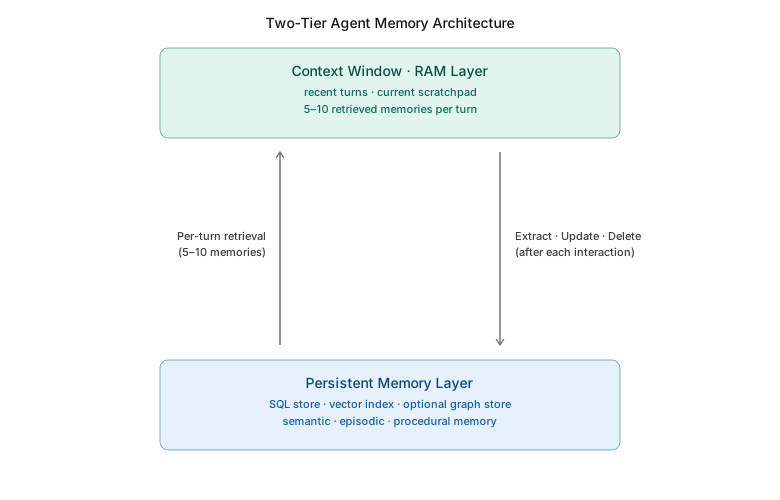
Decision 2: Your two-tier architecture. Context window as RAM is Tier 1: recent turns, the current scratchpad, and the 5–10 retrieved memories relevant to this specific prompt. The persistent memory layer is Tier 2: a SQL store, vector index, or dedicated framework that holds everything else and feeds Tier 1 on demand. The critical number is 5–10 memories per turn, not the full history. Injecting full histories into the context window at retrieval time recreates the storage-as-RAM problem you were trying to solve.
The framework-level evidence for this split is consistent: LangChain’s memory concepts documentation explicitly separates short-term thread-scoped state from long-term cross-thread stores. Redis’s dual-tier approach uses short-term in-memory for working state and durable storage with semantic caching for persistent memory. The two-tier split isn’t an advanced pattern; it’s the standard starting point.
Once these two decisions are made, every downstream choice (what extraction pipeline to build, which retrieval pattern to implement, when to upgrade infrastructure) follows naturally from them. Skipping them and jumping to storage is where most memory rebuilds originate.
Optimize retrieval quality before you scale context size
When agents return poor results, the reflex is often to expand the context window: give the model more to work with and let it sort out what’s relevant. That instinct tends to be both expensive and misdirected.
Mem0’s April 2026 benchmark report puts a concrete number on the gap. Their 2026 token-efficient memory algorithm achieved a LoCoMo score of 92.5 at roughly 6,956 tokens per retrieval call. The full-context baseline, which injects the complete conversation history into the window, required approximately 26,000 tokens per conversation to achieve lower scores. That gap is the difference between a per-turn cost that scales and one that makes production economics difficult.
The improvement came from retrieval architecture, not model capability or context window size. Two specific changes drove the gains: single-pass extraction that treats agent confirmations and recommendations with equal weight to user-stated facts, and multi-signal retrieval that runs semantic similarity, keyword matching, and entity matching in parallel rather than sequentially. The result was +29.6 points on temporal reasoning queries and +23.1 points on multi-hop reasoning compared to the prior algorithm, gains that come from how memories are found and scored, not from how many tokens the model receives.
The practical implementation for most production agents: hybrid dense-plus-sparse retrieval (dense embeddings for semantic similarity, sparse BM25-style matching for keyword precision), query rewriting to handle ambiguous intents, and top-k calibration tuned to your actual query distribution. These are retrieval engineering decisions, not model decisions. The head-to-head comparison of memory frameworks covers how different vendors implement this pattern if you’re evaluating managed options.
The diagnostic test before expanding context: measure retrieval hit rate first. If the agent is missing memories that exist in the store, the bottleneck is retrieval quality. Buying a larger context window doesn’t fix retrieval; it just makes the miss more expensive per query.
Run a memory lifecycle: extract, update, delete — not just store
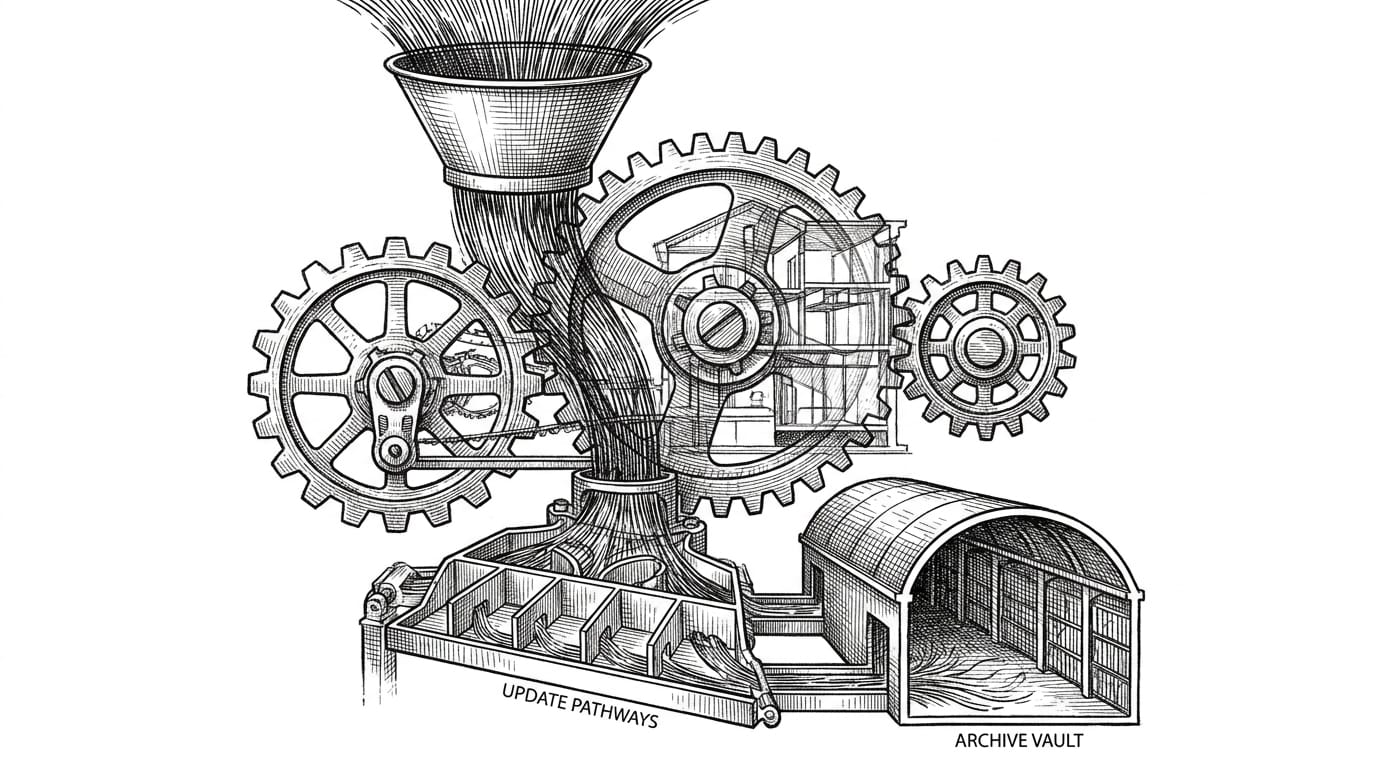
Storage without lifecycle is a memory architecture that degrades. The agent accumulates entries; some become stale (outdated preferences, superseded product specs, old pricing); eventually the memory layer is returning facts that are worse than no memory at all. Teams typically build the extraction pipeline and treat deletion as a future concern. The problem with that choice is that stale memory actively degrades agent output rather than being neutral.
The lifecycle runs three operations — extract, update, and delete — but the extraction step itself uses ADD-only: every candidate gets written as new on the first pass. The compare-against-existing step (decide: add vs update vs delete) runs as a separate follow-on pass after extraction completes, checking new candidates against what’s already stored. On extraction specifically, the extraction step is usually the bottleneck, not the storage technology. In our own production agent systems, adding a self-check gate to the extraction pipeline (where the model reviews its own extraction output before writing) improved extraction yield 8x on the same documents and model. The same architecture on the same data produced dramatically different results depending on whether that verification pass existed.
Single-pass ADD-only extraction — the pattern Mem0’s 2026 report documents — is the right starting model, and a self-check on the output compounds the gains further. The prune-and-archive cadence is an operational discipline, not a technical one: define expiry policies for each fact category before you build the extraction pipeline, not after you’ve accumulated 100,000 entries with no expiry metadata.
For institutional knowledge that changes slowly, one effective complement: compile knowledge into a structured, interlinked set of files the agent maintains over time, updating and integrating as new information arrives rather than re-deriving on every query. This doesn’t replace the extract/update/delete lifecycle for interaction-specific episodic memory; it runs alongside it and tends to produce better retrieval precision for stable domain content.
Combine RAG and agent memory to cut hallucinations

RAG handles static enterprise knowledge — internal wikis, product documentation, contracts, policy files. Agent memory handles interaction-specific facts — user preferences, past task outcomes, commitments the agent made. Each occupies a distinct retrieval namespace; mixing them in one causes retrieval namespace collision, where interaction-derived facts compete in the ranking with static enterprise knowledge and neither type gets clean retrieval.
The distinction is structural. RAG retrieves from a corpus that changes infrequently between queries: the product documentation updated last quarter, the compliance policy revised in March. Agent memory retrieves from a corpus that changes every session: the user’s stated preference from yesterday, the decision made in the last task, the constraint corrected two turns ago. Mixing them in a single retrieval namespace means a user’s casual preference can surface alongside authoritative product specifications, with the retrieval system having no principled way to weight one over the other.
The implementation pattern that works: keep retrieval namespaces explicit and separate, and instruct the model to prefer retrieved content over internal guesses when retrieved content is present. For high-risk outputs, add a verification pass before acting on what was retrieved. The combination of separate namespaces, prefer-retrieved-content instruction, and targeted verification cuts hallucinations substantially more than either RAG or agent memory alone. For organizations where data ownership and privacy are load-bearing concerns, keeping the namespaces explicit also produces a cleaner audit trail.
What your framework gives you for free — and the exact signals that say you have outgrown it
Framework defaults are the right starting point for production agents. That recommendation isn’t hedged. It’s the empirical answer from watching teams over-build Phase 1 infrastructure for a problem their buffer memory would have handled fine. Don’t pre-optimize past the defaults until you have a specific symptom that requires it.
What each major framework gives you at default:
- LangChain/LangGraph:
ConversationSummaryBufferMemoryhandles short-term state with automatic summarization when the buffer fills; LangGraph checkpointers provide session persistence to a database. The cross-thread stores API handles long-term memory when you need cross-session identity. This is the right starting point for most LangChain-based agents. - LlamaIndex: Memory blocks handle FIFO short-term with structured long-term memory. Well-suited for retrieval-augmented workflows already built on LlamaIndex.
- CrewAI: Three-tier model: ChromaDB for semantic retrieval, SQLite for structured storage, entity memory for key entities across sessions. Production-capable at moderate scale without additional infrastructure.
- OpenAI Threads: Managed conversation state with automatic message history. Appropriate for single-model workflows that don’t need cross-session recall.
- Cloud platforms: AWS Bedrock AgentCore Memory and Google Vertex AI Memory Bank are generally available or available in preview as of mid-2026; Cloudflare Agent Memory is in private beta as of April 2026. Each provides managed lifecycle operations without self-hosted infrastructure, the right tradeoff when you need reduced operational burden over architectural control.
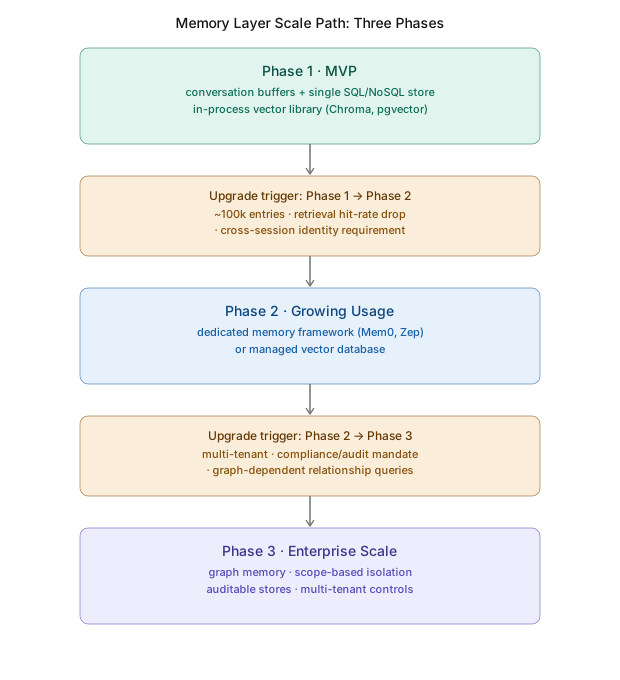
Phase 1 (MVP): Conversation buffers plus a single SQL or NoSQL store plus a lightweight in-process vector library. In-process Chroma or pgvector as a Postgres extension work at this scale. This handles most single-tenant, single-domain agents through their first year in production.
Phase 2 (growing usage): A dedicated memory framework such as Mem0 or Zep, or a managed vector database. The rough trigger is around 100k memory entries, though FC’s observed builds show wide variance by domain and query pattern; some hit retrieval degradation earlier. The signal to watch is performance regression and retrieval hit-rate drop, not entry count alone. For vendor options and head-to-head tradeoffs, the memory systems comparison covers the field in detail.
Phase 3 (enterprise scale): Graph memory for entity relationships that change over time, scope-based isolation for multi-tenant deployments, auditable stores where the history of what was stored and why is a compliance requirement. The upgrade trigger here is a specific, named requirement: multi-tenancy, audit mandate, or relationship-graph queries. Not the general availability of a newer tool.
For a worked example of what Phase 1 looks like as a full production build, our five-layer reference architecture covers the deep dive. And for how memory fits into the broader harness of a production agent, this piece on how agents access what they know provides a complementary view.
Build monitoring, evaluation, and governance from day one
Teams that defer governance until scale tend to discover the problem after a user-facing incident: a stale memory that sent the wrong information, a stored fact that was never deleted after the user corrected it, a memory entry that surfaced in the wrong context. The monitoring and governance tooling is lightweight to build at launch; retrofitting it after the memory layer has accumulated half a million entries is substantially more expensive.
Four metrics to instrument at launch:
- Retrieval hit rate: Did the agent find the relevant memory when it should have? Track the ratio of turns where expected memories were retrieved versus turns where they were missing. This is the primary signal for retrieval quality degradation before users notice it in output quality.
- Token usage per turn: Is context window load growing over time as the memory store accumulates entries? A rising per-turn baseline is the early warning that extraction and pruning aren’t keeping pace with ingestion.
- Latency per turn: Retrieval and injection add latency that compounds at scale. Baseline this at launch; a 200ms retrieval time that doubles to 400ms as the vector index grows is easy to catch early and costly to diagnose after the fact.
- Memory growth over time: Are entries accumulating faster than they’re being pruned? An unchecked growth curve is the leading indicator of a stale memory problem before users feel it in output quality.
Evaluation options: BEAM, LoCoMo, and LongMemEval are the 2026 benchmark trio for standardized evaluation, useful for comparing architectures against published baselines. For most production agents, an internal evaluation set of 20–30 golden-path conversations with expected memory recall outcomes tends to be more useful because it’s domain-specific. Both have a place: the public benchmarks give reproducible architecture comparison points; the internal set tells you whether your agent is actually working for your users.
Governance baseline for enterprise deployments: User-facing inspect, correct, and delete tooling belongs at launch, not as a phase-3 addition. Data retention and deletion policies, right-to-be-forgotten compliance specifically, need to be designed before memories accumulate, not after. Access control (which agent reads which user’s memory) is an architectural decision that’s expensive to retrofit into a single-namespace store. Auditability (what was stored, when, and from what source) is a compliance requirement in regulated industries and a useful debugging tool in every industry. The practitioner’s guide to AI agent governance covers the runtime control patterns that connect to this layer.

Frequently asked questions
How do I start building agent memory without overengineering it?
Start with your framework’s built-in conversation buffer and a single relational store. The two decisions that matter in week one: what the agent should remember (the taxonomy), and where the boundary sits between context window and persistent storage (the two-tier split). Add complexity when you see the symptoms that require it.
What’s the simplest agent memory architecture that still works in production?
Conversation summary buffer (ConversationSummaryBufferMemory in LangChain), a single SQL table for structured long-term facts, and an in-process vector library for semantic retrieval. This handles most single-domain agents through their first year. The upgrade trigger: retrieval quality visibly degrades, or you hit cross-session identity requirements the framework can’t handle.
When should I move from LangChain’s built-in memory to a dedicated memory framework?
Watch for symptoms rather than entry count: the buffer summary is losing facts; retrieval precision has dropped and top-k tuning isn’t recovering it; you need cross-session identity the checkpointer can’t handle. Roughly 100k memory entries is a reasonable guide, but the symptoms are more reliable than the count.
Do I need a vector database to give my AI agent memory?
Not in Phase 1. An in-process vector library — Chroma running in-process, or pgvector as an extension on your existing Postgres — handles semantic retrieval at MVP scale without separate infrastructure. A standalone vector database earns its place when retrieval latency is affecting turn latency or when index size makes in-process operation impractical. Start in-process; move when you have a specific symptom.
How do I decide what my agent should remember versus forget?
Tie each memory category to an expiry policy at the taxonomy stage: session-scoped preferences expire at session end; product and pricing facts expire on source system update; historical task records archive after your defined retention window. Define expiry before you build the extraction pipeline, not after you’ve accumulated entries with no expiry metadata.
How do I keep agent memory from going stale or drifting?
The extract/update/delete lifecycle with a self-check gate handles the stale-entry side; the archive cadence handles drift. Check retrieval hit rate trends monthly. A declining hit rate on well-understood queries usually means stale entries are surfacing, or extraction isn’t capturing updates correctly. Both are fixable at the pipeline level.
How do I evaluate whether my agent memory is actually working?
Mem0’s 2026 algorithm achieved 92.5 on LoCoMo as a published benchmark reference point, useful for architecture comparison. For your production system, build an internal evaluation set: 20–30 golden-path conversations with expected memory recall outcomes, run monthly. The internal set is domain-specific enough to catch failures that matter for your use case.
When does it make sense to use a managed memory service instead of building one?
When the operational cost of self-hosted infrastructure is load-bearing: you don’t have a dedicated infrastructure team, you’re moving fast, or per-query costs are within acceptable range. Managed services trade architectural control for operational simplicity. The memory systems comparison covers the specific tradeoffs across vendors if you’re evaluating options.
How do I combine RAG and agent memory without duplicating work?
Keep the retrieval namespaces explicit and separate: RAG retrieves from your static enterprise corpus; agent memory retrieves from interaction-derived facts. They feed the same context window from different stores. On the extraction side, don’t extract copies of what’s already in your static knowledge base into agent memory — extract only what’s interaction-specific: preferences, decisions, corrections, commitments. The p95 latency on optimized managed memory retrieval can run around 1.44 seconds versus 17 seconds for full-context injection; keeping retrieval systems focused is what makes that efficiency gap achievable.
What monitoring should I put in place from day one?
Retrieval hit rate, token usage per turn, latency per turn, and memory growth over time. These four metrics, logged from day one, give you the baseline to catch every class of memory problem before users feel it in output quality. Add the internal evaluation set around day 60 once you have enough real traffic to build it from. Add user-facing inspect/correct/delete tooling by day 90.
Memory and context management is still, in 2026, largely a craft problem. The tools are available, the benchmarks are improving, and model providers will eventually make more of this automatic. Until they do, the teams investing in the seven decisions above tend to run agents that get better over time. The teams that don’t tend to rebuild the memory layer every six to eight months when the degradation becomes impossible to ignore.
FC builds autonomous agent systems for production operations, including memory architectures for our own internal deployments and for client systems across multiple industries. If you’d rather not navigate this architecture on your own, our managed agent builds include the full memory layer — designed, instrumented, and maintained as part of the engagement.