Anatomy of an Agent Harness: 7 Components You Should Audit
You’re past the pilot. The agent works in demos and probably in staging, and now somebody is asking the real buying question: will it hold up when nobody is watching? That question doesn’t resolve at the model layer. It resolves in the layer of code, configuration, and execution logic that sits around the model, what the industry has started calling the harness.
There are seven components every agent harness has. We built these seven components after reviewing eight published articles by our peers between March and April 2026 from LangChain, Salesforce, Firecrawl, Atlan, Fowler & Boeckeler, Osmani, Schmid, and Hands on Architects.
By the end of this article I hope you will have a deeper understanding of what a harness is, the different ways it can fail, what it does and how to assess the quality of your harness (existing, or when shooping for someone to build an agent from a vendor).
There’s a lot of interest in this topic right now: Anthropic’s annualized revenue grew from $14B in mid-February to over $30B by April 2026. The market is buying. What it’s buying is models. But what’s deciding whether those models earn their keep in production is the harness layer.
One clarification before the components, because the word agent is doing too much work in 2026. When we say “agent” here, we mean model plus harness running self-directed work, not workflow-LLM patterns where every step is human-scheduled. A workflow with an embedded LLM call needs prompt management and an error handler; an agent doing self-directed work needs the entire harness, which is what we are discussing in this article.
The seven components of the harness
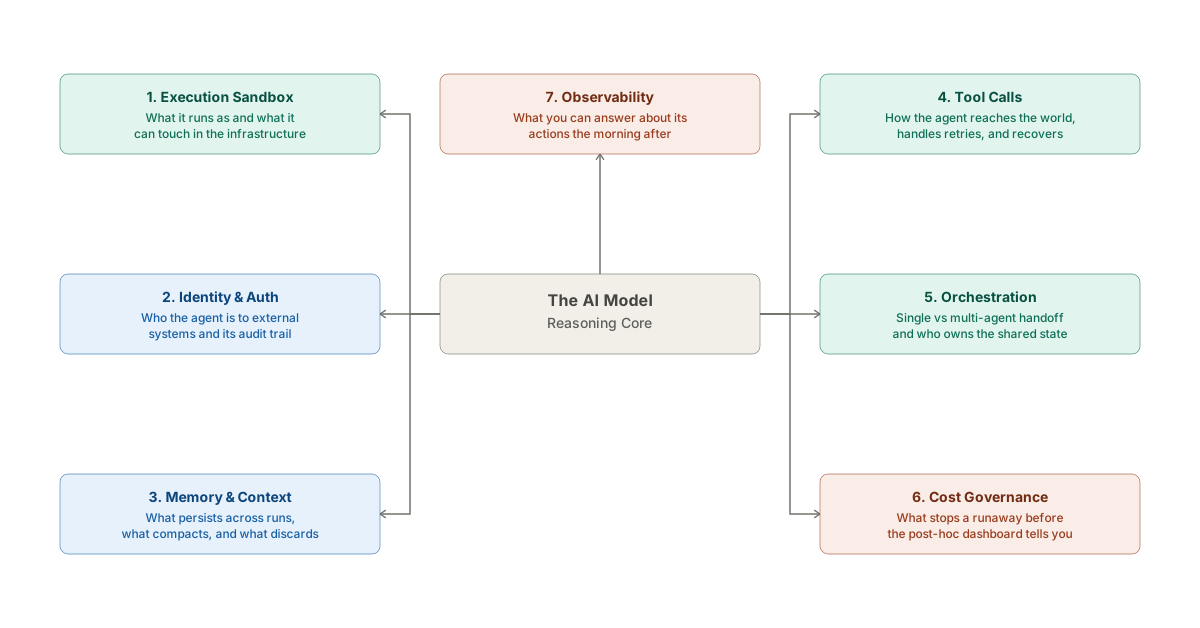
The eight sources above name different subsets of components, the common agreement and synthesis of all the harnesses comes down to:
| Component | What it is | How it can fail |
|---|---|---|
| Execution Sandbox | What the agent runs as and its permissions. | Broad permissions + long-horizon agent creates outsized risk radius. |
| Auth Identity | Who the agent is to external systems. | Shared API keys prevent auditing; child agents break revocation chains. |
| Memory & Context | What persists, what compacts, what discards. | Uncompacted context growth leaks cost; no garbage collection. |
| Tool Calls | How the agent interacts with and reaches the world. | Transient tool failures trigger runaway retry storms. |
| Orchestration | Single-agent loop vs multi-agent handoff, and who owns state. | Multiple agents conflict over stale views of unowned shared state. |
| Cost Governance | What stops a runaway charge before the credit card bill tells you. | Lack of pre-flight circuit breakers allows sudden, massive token spend. |
| Observability | What you can answer the morning after. | Logs confirm a failure occurred but lack structure to explain why. Or no logs at all. |
Component 1: Execution sandbox
Your execution sandbox decides what the agent runs as, where it runs, and what it can reach: filesystem, network, processes, databases, and infrastructure. The decision is your risk radius, and it has to be made before deploy because retrofitting sandboxing later is rip-and-replace work.
The architectural choices fall along a spectrum: container-level isolation, process-level isolation, OS-level isolation, or hardware-level isolation with policy engines on top. See, for example, NVIDIA’s NemoClaw approach with its OpenShell and scoped permissions.
The clearest recent worked example sits in the AI Incident Database, citation 1442: in mid-December 2025, AWS Cost Explorer in one mainland China region reportedly had an approximately 13-hour interruption after Kiro, an internal Amazon AI coding tool, was reportedly allowed to delete and recreate part of the working environment. Amazon disputed the AI-causation account and attributed the issue to user error and misconfigured access controls. In both cases, the root of the issue was the same: the AI’s sandbox permissions were too broad for what the agent could do.
Ask yourself: What can this agent do that I’d be unwilling to let a junior engineer do on day one, and what stops them from doing that?
Component 2: Identity and authentication
Identity and authentication answers a question most teams skip in the rush to ship: who is the agent? And who is it more practically as it relates to external systems, what credentials does it carry, and what’s its audit trail when it acts? The decision is whether to give each agent a dedicated service account with scoped permissions, run it under a shared API key, or impersonate a human user.
The Gravitee 2026 State of AI Agent Security report is the cleanest 2026 data on what production teams are actually doing here. The picture is sobering:
- Only 21.9% of teams treat AI agents as independent, identity-bearing entities
- 45.6% rely on shared API keys for agent-to-agent authentication
- 25.5% of deployed agents can create and task another agent
When an agent on a shared key spawns child agents and one of them does something costly, the chain of command becomes harder to control and audit. The potential failure pattern to watch out for here is the combination (shared key plus multi-agent, plus the ability to spawn), not any single decision. In our experience, this tends to be the component team’s promise to “fix later” and then discover later means: after a costly incident.
Ask yourself: If this agent did something costly in the next hour, could I tell which agent did it, and could I revoke just that agent’s access without breaking the others? How do I manage sub-agent spawning? Are my keys shared too broadly across multiple agents or systems?
Component 3: Memory and context
Memory and context describes what persists across runs, what gets compacted into smaller representations, and what gets discarded. Context-rot and compaction are first-class harness primitives. From our experience operating memory and context controls: the coupling between memory and cost tends to be tighter than either treatment suggests; we’ll get to that in Component 6.
A strong harness here requires that you answer the question of what stores state (vector retrieval, structured state, a hybrid). But there’s also a token discipline at the prompt-construction layer, deciding what gets included on each turn. Plus a compaction policy, deciding when long histories collapse into summaries. Your context window is your “RAM”, and a harness with no compaction policy is a process that never frees memory.
Failures here can look like your agent still gives correct answers, but each turn pulls more context than the last, and the per-task spend grows, while accuracy declines. The architectural fix sits in the memory layer, which is where teams typically look last because the agent is still “working.”
Ask yourself: Where does this agent’s state actually live, how am I managing memory and context in my agent network?

Component 4: Tool calls
Tool calls covers how the agent reaches the world: the tool registry, the calling protocol, the error-recovery behavior. Are tools exposed via an MCP-native registry, hand-wrapped APIs maintained internally, or framework-bundled tool packs you don’t control. The MCP server ecosystem expanded rapidly through early 2026, and most teams we work with end up with a mix of all three.
A serious risk with tools is a retry storm. This is when the agent calls a tool, the call fails transiently (a rate limit, a 503, a malformed response), and the harness has no policy distinguishing retryable from non-retryable failure modes. So the agent retries. And retries. And retries. The cost shows up before the alert does, and the upstream tool sometimes degrades further under the retry pressure.
Ask yourself: How should my tools be built and called? When this agent calls a tool and the call fails, what does it do, and what stops it from doing the same failed call 50 more times?
Component 5: Orchestration
Orchestration answers whether you have one agent in a loop or several agents handing off to each other, and whether the work is event-driven or scheduled. The load-bearing decision underneath is shared-state ownership: is there one canonical source of truth (a file, a database, a queue) that agents read and write through, or is state implicit and distributed across the agents themselves?
Multi-agent systems that fail in production tend to fail here. Two agents act on stale views of the same state, the merge logic was never specified, and the bug is invisible until it’s expensive. Anthropic’s published work on multi-agent research systems is a useful reference for what production adds to the orchestrator-subagent pattern; we covered that ground in our take on the multi-agent blueprint, which gets into the token-cost tradeoff for orchestration specifically.
The orchestration component is also where “we’ll just add another agent” tends to become technical debt. Each agent you add multiplies the number of state transitions you have to reason about, and if the system isn’t built around an explicit state owner from the start, the debt compounds.
Ask yourself: If two agents disagree about what’s true, which one wins, and how do I know? Can misinterpretations from one agent carry forward down the chain to other agents? How are hand offs done between agents?

Component 6: Cost governance
Cost governance covers what stops a runaway: token budgets, rate limits, kill switches, spend caps, pre-flight budget enforcement. Cost governance is the second half of the architectural pairing we flagged in Component 3. Bad memory designs leak cost; cost circuit breakers can’t fix poor context discipline. They can only cap the downside while the upstream architecture is fixed. We’ve written about how the optimization sequence actually plays out (script-first, caching last), and the same logic applies here: governance lives at the harness layer, not at the dashboard layer.
Ask yourself: What’s the maximum spend (in dollars and in irreversible state changes) this agent can incur in the next time interval (hour, day) without human approval?
Component 7: Observability
Observability is what you can answer the morning after. Structured event logs, traces, cost and latency metering, decision audit trails. Observability quality tends to decide how fast you can recover from anything that goes wrong in the other six components.
The architectural decision is whether to emit structured event logs at the harness layer (queryable later), scrape ad-hoc logs from individual agents (slower, lossy), or rely on vendor-provided dashboards (good for some questions, bad for the questions you didn’t anticipate). The trade-offs and what they look like at each deployment stage are the topic of our piece on operational decisions at each deployment stage. The three-monitoring-layers question, in particular, lives in this component.
Your risk here: something goes wrong overnight, and the team can answer that something went wrong (the bill, the alert) but not why. The runbook says check the logs; the logs were never structured to answer this kind of question.
Ask yourself: What can I answer about what this agent did yesterday, and how long does the answer take to produce? How quickly do we get notified for issues?
The 30-minute audit checklist
These seven questions can help you prevent the failure patterns while getting your harness ready for production:
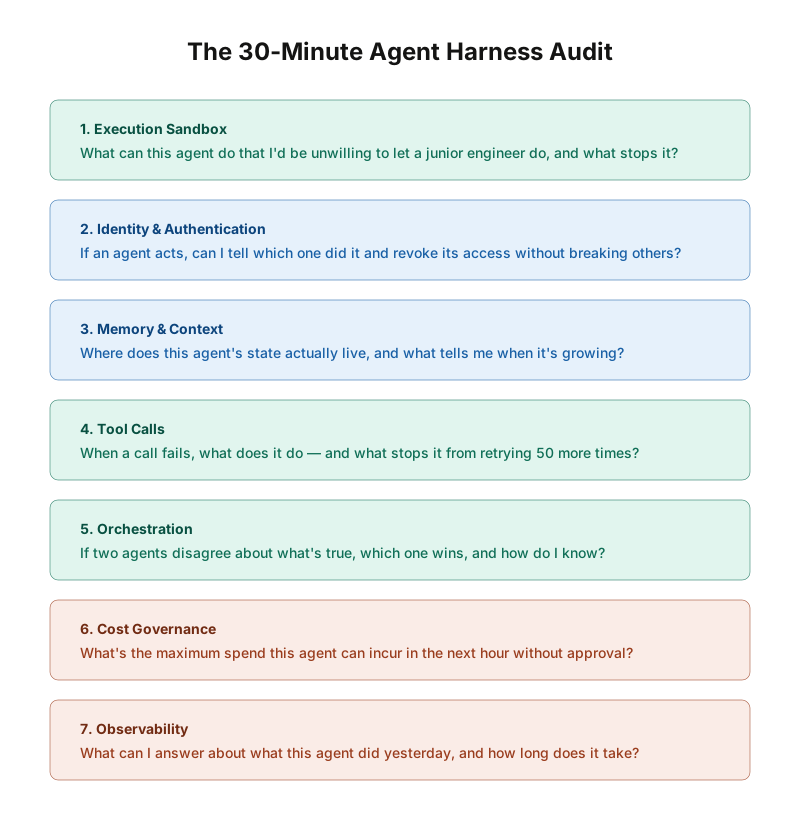
- Execution sandbox. What can this agent do that I’d be unwilling to let a junior engineer do on day one, and what stops it from doing that?
- Identity and authentication. If this agent did something costly in the next hour, could I tell which agent did it, and could I revoke just that agent’s access without breaking the others?
- Memory and context. Where does this agent’s state actually live, and what tells me when it’s growing in a way it shouldn’t?
- Tool calls. When this agent calls a tool and the call fails, what does it do, and what stops it from doing the same failed call 50 more times?
- Orchestration. If two agents disagree about what’s true, which one wins, and how do I know?
- Cost governance. What’s the maximum spend (in dollars and in irreversible state changes) this agent can incur in the next hour without human approval?
- Observability. What can I answer about what this agent did yesterday, and how long does the answer take to produce?
A vendor demo or an internal architecture review that gets clean, specific answers has made a good start at designing an effective harness layer. A demo where two or three answers turn into “we’re planning to add that” is a system where the production-readiness work hasn’t been done yet.
Bottom line
A bad harness is just a brain in a jar. You need a solid harness to give your agent the eyes, ears and system capable of operating in your business environment effectively. We hope that these questions give you a head start in your self-evaluation process as you evaluate your internal progress or that of a vendor when selecting your next partner to help you build your agentic applications.
If running the harness layer yourself isn’t where you want to spend your time, we build and operate agentic systems for clients. You can learn more abour our managed autonomous AI agents, or contact us to find out more.
FAQ
What is an agent harness in AI?
An agent harness is every piece of code, configuration, and execution logic around the model. LangChain’s Vivek Trivedy describes it as “every piece of code, configuration, and execution logic that isn’t the model itself.” The model is the reasoning core; the harness is the operational software around it that handles tools, memory, identity, sandboxing, orchestration, cost controls, and observability. In production agent systems, the harness tends to determine whether the model’s output translates into reliable work.
What is the difference between an agent harness and an agent framework?
An agent framework (LangChain, LangGraph, AutoGen, CrewAI, and similar) is a library that gives you primitives for building agents: chains, tool-calling abstractions, memory interfaces. A harness is the integrated runtime that sits around the model in production, including everything the framework provides plus the things frameworks don’t: sandbox policies, identity boundaries, cost governors, observability pipelines. Firecrawl’s April 2026 piece draws this distinction clearly: a framework helps you build; a harness is what runs the result.
What are the components of an agent harness?
The union view across the eight major published definitions consolidates into seven components:
- Execution sandbox: where it runs, with what access
- Identity and authentication: who it is to external systems
- Memory and context: what persists and what compacts
- Tool calls: how it reaches the world
- Orchestration: single-agent loop vs multi-agent handoff, and who owns state
- Cost governance: what stops a runaway
- Observability: what you can answer the morning after
Why does the harness matter more than the model?
Through early 2026, eight major publishers (LangChain, Salesforce, Firecrawl, Atlan, Fowler and Boeckeler, Osmani, Schmid, Hands on Architects) independently shipped harness-definition pieces — convergence on the harness as the decisive layer for production reliability. The model handles reasoning; the harness handles whether that reasoning translates into reliable work.
How do I evaluate whether an agent system is production-ready?
The 30-minute checklist above is the short version: seven operator questions, one per component. A system that answers all seven cleanly has been architected through the harness layer. A system that slides into “we’re adding that” on two or three components has work ahead, and the production-readiness timeline is probably longer than the demo suggests. The Gravitee 2026 report found 21.9% of teams treating agents as identity-bearing entities, which is a useful sanity check on what “ready” looks like across the field. Most production systems still have meaningful gaps, and naming them honestly is more useful than papering over them.