AI Cost Optimization: A Practitioner Framework
An AI system that’s starting to cost real money is a different problem from an AI prototype, whose job was to prove a model could do the thing. The production system’s job is to do the thing at a margin that justifies its existence. Teams usually cross that line without noticing. The bill climbs steadily, then jumps, then someone runs the math and the project is suddenly under cost review.
This is some of the work we do for clients. We get hired to come, review an AI system that’s working but expensive, find the architectural waste, and bring the spend down without dropping quality. The framework in this article is the approach we actually use.
In this article:
- Why cost optimization is quality optimization in disguise, and how to tell when you’ve crossed into degradation
- The Script-vs-LLM Substitution Rule and the misallocation question
- Dispatcher-First Cost Architecture: the architectural decision that produces the largest savings
- Why agent decomposition lowers cost AND raises accuracy
- The Haiku scratchpad case: getting Sonnet-quality answers at Haiku prices by changing the prompt
- The optimization sequence, ordered by ROI per engineering hour
- The Accuracy-Speed-Cost Triangle: the ceiling you meet after the structural work is done
If runaway cost is the failure mode you’re worried about, the AI Agent Cost Circuit Breaker covers the reactive side. This article is the proactive side: how to design a system that doesn’t run away in the first place.
Cost optimization is quality optimization in disguise
The most common framing of AI cost optimization treats cost and quality as a tradeoff dial: turn the cost down, accept some quality loss, find the spot you can live with. That framing is wrong, and it produces the wrong techniques.
The goal of cost optimization is to make the process more efficient, more accurate, and often faster. The cost savings emerge from that. When you go deep on cost optimization, you end up doing a careful analysis of the process: what each step actually does, what model tier each step actually needs, which calls shouldn’t be model calls at all. That analysis improves the system on every axis. Lower cost emerges from that work as a consequence of the deeper process analysis.
Cost optimization that drops quality below tolerance is just the wrong solution. That’s degradation of service. If a “savings” plan ends with the system producing worse outputs, it didn’t optimize. It switched to a different, worse system.
This lens changes the question you ask of every technique. Instead of “how much cheaper does this make us?” the question is “does this improve the system or does it degrade it?” Techniques that improve the system on multiple axes (accuracy, speed, reliability, cost) are the ones to chase first. Techniques that trade quality for cost belong last, sparingly, and only when the quality drop is genuinely tolerable for the use case. The industry literature corroborates the connection. aisuperior.com frames systematic optimization as producing both cost reductions and quality improvements together. The same analysis that finds the waste also finds the quality bugs.
The Script-vs-LLM Substitution Rule
The largest savings in most AI systems aren’t hiding in model selection. They’re hiding in calls that should never have been LLM calls at all.
The heuristic is the Script-vs-LLM Substitution Rule: scripts for determinism, LLMs for judgment. If a task has a defined input shape and a defined output shape, and the transformation between them is mechanical, a script does it exactly, in milliseconds, for fractions of a cent. The moment you put an LLM in that spot, you’ve added cost, latency, and a non-zero error rate to a task that didn’t need any of them.

The substitution candidates show up in almost every AI system once you go looking. File-existence checks, status notifications, structured-data comparisons, format conversions, date math, URL canonicalization. Every one of these running on a premium reasoning model is dollar-bleed without quality justification, and the failure modes (hallucinated dates, off-by-one comparisons) are worse than the script equivalents.
The boundary case matters. When judgment is genuinely required (ambiguous input, context-dependent interpretation, decisions that require reading subtext or weighing trade-offs), the direction reverses. Don’t script what genuinely needs an LLM. Scripts for the deterministic stuff, LLMs for the judgment stuff, and don’t mix them up.
This is the same insight at the center of our Four Axes of AI Agent Efficiency framework. The Script-It axis specifically targets entire sessions that shouldn’t have been LLM calls in the first place. In production audits we’ve found this is consistently the largest single cost lever, bigger than model downgrades, prompt compression, or caching.
The stakes for getting this wrong are non-trivial. Gartner has projected that over 40% of agentic AI projects will be canceled by 2027 due to escalating costs and unclear value. A large share of that escalation traces back to LLM-everywhere architecture, putting an expensive reasoning model into spots where a five-line script would have served. The substitution rule is the cheapest, fastest fix for a runaway bill. And there’s no trade hiding under it: the script is cheaper, faster, and more accurate than the call it replaces.
Dispatcher-First Cost Architecture
The single highest-leverage architectural decision in AI cost optimization is putting a lightweight dispatcher in front of every premium-model call. We call this Dispatcher-First Cost Architecture: every inbound task routes through a gatekeeper (a script or a low-cost model) that decides which downstream agent or model handles it. No speculative engagement of high-cost models.
The academic backbone is well-established. Stanford’s FrugalGPT paper showed that a cascade architecture (try cheaper models first, escalate on failure) can match GPT-4 performance with up to a 98% cost reduction across natural language tasks. The RouteLLM framework from LMSYS reached similar territory on MT Bench, with 85% cost reduction at production-equivalent quality.
The lesson under the numbers is more useful than the percentages themselves. The majority of queries don’t need the most expensive model. A trained dispatcher classifies task complexity and routes accordingly; the premium model gets engaged only when the cheaper tier fails or the complexity score crosses a threshold.

Here’s how this looks in our own content pipeline. We run an autonomous agent stack on Anthropic Claude Opus, Sonnet, and z.ai GLM-5, with daily spend in the $15-20 range. Each pipeline stage is pinned to the model tier the task actually needs: GLM-5 for data gathering, Opus only when synthesis or judgment is required, Sonnet for art direction. The dispatcher isn’t a separate service; it’s the stage definition itself, because we pre-classified each stage during architecture. A config bug that sent all six content stages to Opus tripled the per-article cost before we caught it. Per-stage model pinning is what makes that recoverable.
Dispatcher architecture earns its complexity when task complexity varies significantly. On a uniform workload, the dispatcher adds latency, code surface, and a place for bugs to hide without giving you a savings lever to pull. The decision rule: if your workload has at least two distinguishable complexity tiers (and most do, once you look), the dispatcher pays for itself. If everything is genuinely a high-end reasoning task, route directly and skip the dispatcher.
Model pinning at the dispatcher layer is also a governance control. The governance practitioner’s guide covers this overlap in more detail. Runtime model selection is one of the controls that protects against unintended escalation, security as well as cost.
Agent decomposition lowers cost AND raises accuracy
If one technique deserves to be at the top of the priority list once script substitution is done, it’s agent decomposition. The pattern: take a single task you’re sending to a large model and split it into a sequence of smaller subtasks, each running on a smaller model tier appropriate to that subtask.
The economics are direct: if one large model is doing a process, that can be very expensive. Break it down into several smaller sub-steps with small models, and each one of those small models might cost a tenth or even a twentieth of the price of the larger model. Multiply that across the steps and the per-task spend drops dramatically.

The non-obvious second benefit is the one most cost-optimization guides miss. Smaller models on focused subtasks often outperform a single large model on the bundled task. The reasons are mechanical: each subtask has narrower context, narrower failure modes (each step has one job, and you can evaluate it in isolation), and easier debugging. Accuracy goes up because the system is easier to reason about, not because the smaller models are individually smarter.
Decomposition also frees you to run independent subtasks in parallel where the data flow allows it, which pulls latency down on top of cost. Three things move together: cost down, accuracy up, often speed up too. No trade-off.
Decomposition has a cost of its own. It adds coordination overhead: state passing between steps, error handling at each boundary, monitoring across the chain. For single-call workflows or short pipelines, the overhead isn’t worth it. The threshold is roughly: if the task has at least three distinct phases that could plausibly run on different model tiers, decomposition pays. For a one-shot answer task with a uniform reasoning load, keep it monolithic.
Our deployment operational decisions article covers the lifecycle questions around when to decompose and when to consolidate. Decomposition is one of the moves you make as a system matures.
The Haiku scratchpad case: make cheaper models smarter before escalating
Sometimes you can get the answer quality of a higher tier at the price of a lower tier, not by switching models but by changing the prompt. The technique is to force the cheaper model to reason in writing before it answers. Give it a scratchpad (a file, a structured output field, anywhere it can lay out its thinking step by step) and require it to write reasoning before producing the final answer.
Here’s a direct case: We ran a large-volume sandbox test on Haiku and another on Sonnet, measuring how often the model produced a failure (wrong decision, wrong recommendation) using a secondary LLM as evaluator against a fixed control criteria. Haiku failed 4% of the time. Sonnet failed 0% of the time. Per-call, Haiku was substantially cheaper, but the error rate made it look like Sonnet was the right choice.
Then we changed the Haiku instructions: before producing an answer, write your reasoning to a scratchpad file. Only after that, give the answer. We re-ran 250 tests. The Haiku error rate moved from 4% to 0%. The per-run cost rose trivially, a few hundred extra output tokens of reasoning, and Haiku stayed substantially cheaper than Sonnet for the same volume of work. Sonnet-quality answers at Haiku prices.

The same approach works between Sonnet and Opus on harder tasks. Force the mid-tier model to write reasoning before answering, and the gap to the premium tier closes for some workloads. Not all. Scratchpad-forcing has limits. Some tasks genuinely need Opus-tier reasoning and no prompt design closes that gap.
Before reaching for a model upgrade on high-volume tasks where the per-call cost delta is large, run the scratchpad test. The cases where it works are the cases where you save the most — and once again, all three axes move the right way: cost down, accuracy up, with a small speed cost from the extra output tokens that’s typically dwarfed by the spend reduction.
The optimization sequence
In rough order of priority, here are the optimization levers you should look to start pulling:
- Script substitution. Audit the system for LLM calls that don’t require judgment. Replace them with scripts. Biggest savings, lowest complexity, fastest to ship. Days of work for sustained spend reduction.
- Model pinning by stage. If different parts of your system have different complexity requirements, pin each to the right model tier. Don’t run everything on Opus. Moderate complexity, large savings, weeks of work.
- Dispatcher architecture. Once stages are pinned, formalize the routing layer. A lightweight dispatcher in front of premium calls multiplies the savings from steps 1 and 2 and prevents future drift back to expensive defaults.
- Agent decomposition. Split monolithic tasks into focused subtasks running on appropriate tiers. Hits the cost+accuracy dual benefit, and unlocks parallelism on top. Higher engineering effort but the highest ceiling on savings.
- Scratchpad-forcing on the smaller tier. Before escalating to a larger model, force the cheaper one to write reasoning before answering. Often closes the quality gap at a trivial output-token cost.
- Context trimming and prompt compression. Tools like Microsoft’s LLMLingua compress long prompts by single-digit multiples with minimal semantic loss. Lower-leverage unless your prompts are unusually long, but worth measuring once the architectural moves are done.
- Caching layers. Prompt caching for repeated context and semantic caching for near-duplicate queries. Pure-cost wins when repeated context is common in your workload; cache hit rate is the predictor of value. You can also create fun hypercubes by caching the output of a multi-dimensional query struct and then cache each answer in higher order geometry and reduce your LLM costs to zero by serving identical outputs from identical inputs where the conditions are identical and skip your AI costs entirely.
- Batch API and subscription balancing. Discounts for non-time-sensitive workloads and subscription versus pay-as-you-go decisions. Real but modest savings, lowest engineering effort. Do these last.
The sequence above is what we’ve used across cost-optimization engagements with PrograMate.ai, Unleashed Consulting, Black Gazelle, AI Governance Portland Organization, and the Wiseman Group. In each case, the largest savings came from steps 1-4: substitution, pinning, dispatching, decomposition. The lower-leverage moves closed the remaining fraction of savings but were never where the heavy lifting happened.
The Accuracy-Speed-Cost Triangle: the ceiling, not the starting point
Once the structural moves above are done — calls that shouldn’t have been LLMs replaced with scripts, stages pinned to the right model tier, monolithic tasks decomposed and parallelized where possible, smaller models given scratchpads — you arrive at the Accuracy-Speed-Cost Triangle. This is the end state. Up to this point, the right techniques made the system faster and cheaper and more accurate at the same time. From this point on, that stops being true.
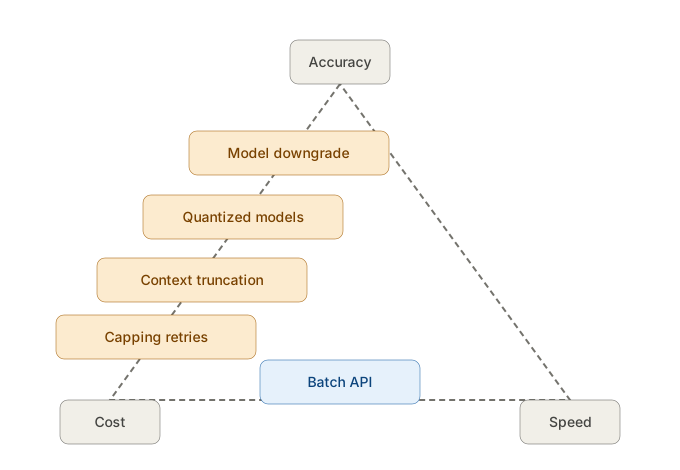
The triangle has three corners — accuracy, speed, cost — and at the ceiling, every additional lever you pull moves two of them in opposite directions. To get cost down further, you have to give up speed, accept some quality drop, or both. Examples of choices that genuinely sit on the triangle:
- Batch API for non-time-sensitive work. Real cost savings, but the request now takes hours or a day instead of seconds. Trade: cost ↓, speed ↓.
- Model downgrade beyond what scratchpads can recover. When you’ve already tried prompt design and the smaller tier still fails on a measurable share of your workload, taking the downgrade anyway buys cost at the price of accuracy. Trade: cost ↓, accuracy ↓.
- Quantized or distilled in-house models for high-volume routine work. Cost falls, output quality narrows on edge cases. Trade: cost ↓, accuracy ↓ at the tails.
- Context truncation past the safe threshold. The lossless compression already happened in the structural phase. Pushing further trades quality for incremental savings. Trade: cost ↓, accuracy ↓.
- Capping retries, fallbacks, or self-correction loops. Saves call volume, increases the rate at which the system ships a wrong answer. Trade: cost ↓, accuracy ↓.
All is not lost though once you reach the ceiling, because the ceiling itself moves. New model releases that match a higher tier’s quality at a lower price shift the triangle outward. A model capable enough to consolidate two stages of your decomposition into one moves it again. Provider pricing changes can move it overnight. Ideally you have the time to review your cost structure over time, especially after a major movement in the market.
Putting it together
Teams that try cost optimization without an organizing framework may run into the following failure modes:
- Reaching for the triangle before the structural moves. Treating cost and quality as a tradeoff dial from day one, when most of the savings sit in techniques that improve both at once.
- Optimizing the wrong layer. Caching when the real waste is misallocated LLM calls.
- Chasing token price without checking quality. Downgrading to a model that produces worse outputs and calling it a win. Or worse, downgrading the model and not testing sufficiently to validate the quality remained the same.
- Hidden ops costs in self-hosting. The math rarely works at small or mid scale once you account for engineering time.
- Dispatcher overhead on uniform workloads. Adding routing complexity where there’s no complexity variance to benefit.

If you want to model the savings on your own system before changing anything, the AI Agent ROI Calculator walks through the inputs that determine where your spend actually is. If you’d rather have someone come in and do the audit, that’s what our managed autonomous AI agents service exists for. Either way, the same framework applies: find the architectural waste first, then the token waste, then the trade-offs at the ceiling, in that order.
Frequently Asked Questions
How much can a typical AI system reduce costs through optimization?
Industry benchmarks land in the 40-70% range for systematic optimization applied to a production system. When optimization compounds with process improvements, when the analysis reveals waste that was hiding in architectural decisions, order-of-magnitude reductions (200-1,000%) are achievable but not typical. Set expectations at 40-70% as the base case.
What’s the cheapest model that still produces production-quality output?
It depends on the task, and the question is usually asked too early. Before picking a model tier at all, run the structural sequence: replace misallocated LLM calls with scripts, decompose monolithic tasks into smaller-tier subtasks, and try scratchpad-forcing on the smaller tier. After that, the cheapest model that hits your quality bar on a representative sandbox test is the answer — and it’s typically smaller than the one you’d have chosen without the structural pass.
When should I switch from a frontier model to a smaller one?
After a sandbox test shows the smaller model meets your quality bar on a representative workload. Before tier-jumping down, try scratchpad-forcing on the smaller model. Sometimes you get the quality you need at the lower price without the switch.
How do I decide between an LLM call and a deterministic script?
Apply the Script-vs-LLM Substitution Rule. Scripts for determinism (defined inputs, defined outputs, mechanical transformation). LLMs for judgment (ambiguous input, context-dependent decisions, reasoning about trade-offs). If a task has a single right answer that doesn’t depend on context, it’s a script.
Is self-hosting cheaper than paying API fees?
Rarely at small or mid scale. The math looks tempting (GPU hours versus API fees) but the hidden costs (engineering time, MLOps tooling, model updates, downtime, security) dominate the bill in practice. Self-hosting starts paying off at scale levels most production systems don’t reach. At the scale where it does pay off, you usually want a hybrid: hosted for the high-volume routine work, API for spike-load and frontier-capability calls. This could change though over time as performance of self hosted models meet and exceed current higher tier models.
How does dispatcher routing actually work?
A lightweight component (often a smaller model or a deterministic classifier) receives every inbound task and decides which downstream agent or model handles it. Stanford’s FrugalGPT cascade is the academic reference: try cheaper models first, escalate on failure or low confidence. RouteLLM trains the router on Chatbot Arena data to classify task complexity and pick the model tier. In production, the dispatcher can be a routing script that maps task type to model tier, or a trained classifier.
What’s the right balance between subscription pricing and API pay-per-use?
Volume threshold. If your monthly usage consistently exceeds the breakeven point of a subscription tier, lock in. If it’s variable or below the breakeven, stay pay-as-you-go. For systems with mixed workload (steady baseline plus spike load), a hybrid often works: subscription for the baseline, API for the spikes. Re-evaluate quarterly as usage patterns shift.
Can I optimize cost without sacrificing quality?
Yes — and it’s the default, not the exception, until you reach the triangle. Cost optimization that drops quality below tolerance is degradation of service, not optimization. The techniques that pull cost without dropping quality (substitution of misallocated calls, model pinning by stage, decomposition, scratchpad-forcing, prompt caching) are the ones to start with. Techniques that genuinely trade quality for cost belong at the ceiling, sparingly, and only with measurement.
How long does it take to see ROI from AI cost optimization work?
Model pinning: a week or two. Script substitution and dispatcher architecture: weeks to a month, depending on workload complexity. Full sequence including decomposition, caching, and batch processing: a few months for a mature production system. The savings start showing up in the bill immediately after the first deployment, which makes the work easier to justify than most engineering projects.
What are the most common AI cost optimization mistakes?
Starting at the wrong layer, going after caching and batch APIs before checking for misallocated LLM calls. Chasing token price without measuring quality, so you discover later that you switched to a cheaper model that fails more often. Hidden self-hosting costs that aren’t visible until the engineering time bill arrives. Adding dispatcher complexity on workloads that don’t have the complexity variance to benefit from routing. Every one of these traces back to reaching for tactical levers before doing the structural audit — treating the Accuracy-Speed-Cost Triangle as the diagnostic tool when it’s actually the ceiling.