
How to Find AI Opportunities in Your Business: The Three-Pathway Framework
There is a lot of published guidance on how to prioritize AI projects once you have a list. The harder, earlier step is finding which opportunities exist in your specific business. Business owners tend to stall here: they know AI is relevant in the abstract but cannot map it onto their own operations. This article is aimed at helping you figure out how to put this all into practice. It covers three pathways that account for every type of AI value, a two-pass team interview you can steam and run within your organization right away, and some discussion around unblocking businesses who assumed they needed cleaner processes before they could start on the AI digital transformation journey.
Once you have that list, you would move to prioritization of your initiatives. If you already have a list of AI ideas and need to rank them, you could pop on over to this article: 5-Criteria Scoring Framework which goes into it deeper.
Finding AI opportunities and prioritizing them are two different jobs. This one is the finding tool.
Prioritization gets most of the attention. Weighted scoring models, ROI calculators, five-criteria frameworks. Those tools are useful, but they assume you already have a list to work from.
Finding the opportunities is the earlier step, and in our experience it is the harder one. It requires walking your own operation and recognizing which recurring activities map onto something AI can actually do. That recognition does not happen automatically as there is a lot of misconception of what AI can do, either thinking it can do way more than it can, or the opposite that it is untrustworthy, leads to errors and has no clear path.
The three pathways: every AI opportunity falls into one of three types
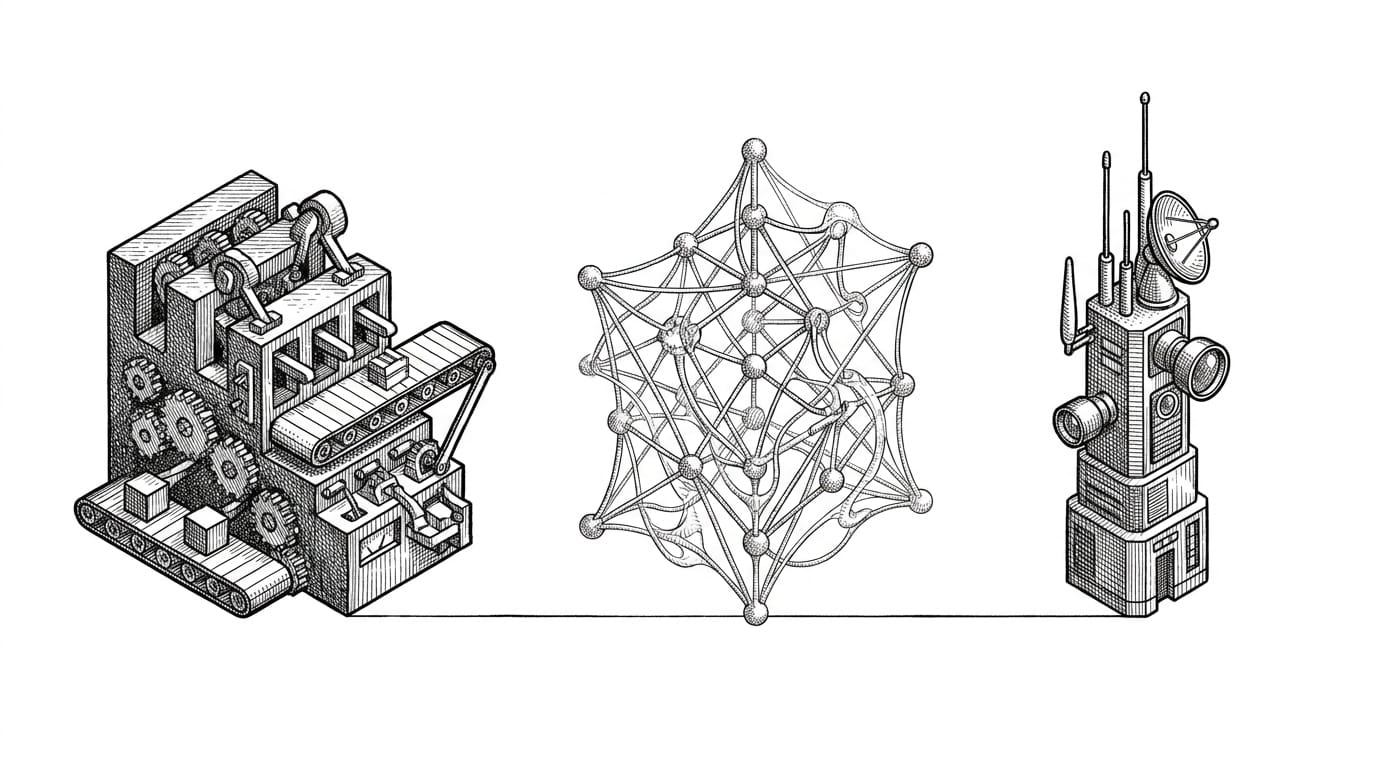
I find that every AI opportunity a business can pursue falls into one of three categories:
- Automation
- Knowledge (Inquiry)
- Analysis (Research)
These can be combined, which we will see later on, but these three is all you need to hold in your head while walking through your teams, departments and your own operations when asking yourself whether an idea or fit exists.
| Pathway | What it does | Concrete example |
|---|---|---|
| Automation | Runs a recurring process as a chain of deterministic steps, with judgment steps (LLMs) inserted only where judgment is actually needed. Not every step requires AI. | Email attachment intake: every inbound email with an attachment gets tracked in a project management tool, stored in the correct location, and renamed by sender and matched project number. If something is missing, the system replies to the sender requesting it. Deterministic steps, one judgment step, one autonomous action. |
| Knowledge | Stores your organization’s knowledge in a system you can query directly, organized by role and permission scope, so people (and future agents!) can get answers the business already knows but could not previously surface quickly. | Role-scoped knowledge store: data organized by role and access level, vectorized so you can ask it questions directly. The institutional knowledge that used to live in one busy person’s head becomes accessible to anyone with the right permissions. |
| Analysis | Monitors data and looks for patterns. Triggers alerts or downstream actions when thresholds are crossed. On its own it produces insight; combined with other pathways, it acts. | Ad KPI threshold monitoring: when performance falls below or rises above a defined threshold, the system triggers alerts, warnings, or downstream actions tied to that specific change, without waiting for a human to check a dashboard. |
Not every step in an Automation requires an LLM. In the email intake example, storing and renaming the file are deterministic. The step where the system decides whether something is missing and what to ask for is where the judgment model earns its place. Mixing these two things together is what makes automations genuinely useful rather than brittle scripts with a chatbot taped on.
Knowledge is about permission scoping as much as retrieval. A well-built knowledge store reflects who should be able to ask what. Not every employee needs access to everything, and the architecture should reflect that from the start.
Finally, analysis, which includes research, can be genuinely useful on its own (for humans reports) but produces more leverage when combined with other pathways (analysis triggers or is triggered by automation; analysis builds/uses knowledge).
The multiplier: when two pathways combine, the value compounds
Single-pathway systems are useful. Combined-pathway systems open up compounding values, because the infrastructure built for one pathway becomes the foundation for the next. Here are some examples of combinations:
- Automated research: Every time an inbound email arrives about a prospect, the system grabs the identifying data, runs research against trusted sources, scores the results, and promotes the top items to the urgent stack. The output of the system is prioritized pre-researched candidates for a person to act upon.
- Automated analysis: Automated analysis of ad campaign performance where the moment the threshold breaches a KPI, it fires a response rather than waiting for a human to notice. The analysis runs on a schedule or a trigger. The action to apply a correction then happens automatically.
- Knowledge-analysis: Analysis that writes its findings back into the knowledge store, so the next question the business asks gets answered using accumulated patterns rather than a fresh scan. The system compounds over time rather than starting from scratch each time.
This is important to keep in mind because solving or building one of the 3 areas will enable more sophisticated operations in the other two pathways.
Automations vs. Agents
An Automation executes a fixed script. When you have defined inputs, you get defined steps, and then a deterministic output. It does not make new decisions; it runs the flow you designed. The email attachment intake is an automation. It handles every case its rules cover and flags the cases it cannot. Automations are reliable, predictable and therefore very desirable.
An agent is what you get when the system decides what to do next in service of a goal. That is the actual jump. Agency means taking action on its own initiative rather than executing a predetermined flow. An agent perceives its situation, reasons about an objective, and acts. For best accuracy this can be between two or more automations, so you keep the determinism of the automation, but use an agent [LLM] for the judgement call between different options that used to require a human to perform. (For a thorough treatment of what that distinction means in practice, see What Is an AI Agent? A Business Leader’s Guide.)
How to spot AI opportunities in your business: the two-pass team interview
Below is a two-pass team interview script. This script is designed to help surface AI opportunities without requiring anyone on your team to have existing AI knowledge. The idea is you bring each department through these questions in sequence, and the “sequence” is the whole trick that uncovers your opportunities.
Start with broader questions aimed at uncovering how people are doing, where they have problems, where they want solutions applied in their job.
People usually cannot answer framework questions cold. Ask someone “do you need automated research?” and most will say “erm, no”, because they are not thinking in those terms. These first questions extracts pain in the team’s own language. The second pass of questions returns to that pain with structured prompts mapped to each pathway. So the idea is you classify after you listen, not before.
Pass one: open-ended pain. Ask these questions and record every answer without editing or classifying yet.
- Where are you wasting time?
- What work are you doing, that you wish you did not have to do?
- Are there opportunities you wish you could pursue right now that you currently can’t?
Pass two: pathway-tagged prompts. Return to the pain points from pass one, and work through a structured set of prompts designed to surface ideas within each pathway.
- (Automation) Is there automatic (storing / organizing) of things you wish happened without manual work?
- (Knowledge & Inquiry) Do you have knowledge that takes a long time to find, or that only lives in certain people’s heads?
- (Analysis & Research) Is there research you wish could happen automatically?
- (Agent tell) Are you spending significant time on general administrative work that a capable virtual assistant could absorb?
That last question is what I call the “agent tell”. When a team describes a large category of varied administrative work that does not reduce to a fixed set of rules, the right answer is likely an autonomous agent. (As of this writing: Fountain City works with two agent frameworks for exactly this kind of open-ended work: OpenClaw and Hermes, which handle different layers of the same agentic stack.)
After both passes, you will have a list of pain points tagged to pathways. This is the list that you can take into prioritization. If you would rather run this exercise with a practitioner in the room, we’d love to help, you can check out our AI Strategy and Roadmap session.

The leapfrog: building automation creates process
The old rule was that you needed documented processes and reasonably clean data before you could automate. Under-systematized businesses were therefore disqualified: fix the process first, structure the data, then layer in AI.
That rule is breaking. Building the automation now forces the process into existence.
A machine cannot run an undefined process. When you build the automation, you are compelled to define every step precisely and structure the data as you go. The act of building becomes the act of process definition. Organizations with weak process and inconsistent data can leapfrog from zero straight to process-and-automation together, in one move, rather than sequentially.
Fountain City’s approach to client work is “understand the process, organize the data, then build the technology that runs it” (see our services overview). In practice, building the technology is often what finally forces the understanding and organizing to happen. The sequence is the same; the forcing function is the build itself. Small and mid-market businesses that have been running on institutional knowledge and informal habit often find that the automation project becomes the documentation project. Two outputs for roughly the cost of one.

The cost is falling: what was out of reach last year is worth building this year
Two things are moving at once: what is possible is expanding, and the cost to build it is falling.
The practical implication: opportunities that were too small or too expensive to bother with a year ago are worth building now. The category of things that are worth automating keeps growing. That line keeps moving in the owner’s favor, and in our experience it moves faster than most people expect.
Foundations and next step
Want to dive into any related topics deeper from here?
For governance in production AI systems, see Agent Governance in Practice. For readiness and adoption groundwork, the AI Readiness Checklist and our AI Change Management framework cover the preparation work in detail.
Finding opportunities on your own is doable with the method above. Classifying them correctly, sequencing them, and knowing which one to build first is where an outside practitioner tends to earn their keep. If you feel you are there, you could be at the entry point to Fountain City’s AI Strategy and Roadmap session: a facilitated working session that moves you from “I know AI is relevant” to a prioritized, buildable plan.
Once you have the opportunities identified and prioritized, Fountain City builds them. Most of that work lands in Agentic Development or custom SaaS applications, depending on scope. The logical next read from here is the 5-Criteria Scoring Framework: how to rank the opportunities you have just found.
Frequently asked questions
How is finding AI opportunities different from prioritizing them?
Finding is the step where you identify which activities in your business could benefit from AI. Prioritizing is where you rank those candidates by criteria like feasibility, cost, and business value. This is the finding step. The 5-Criteria Scoring Framework covers prioritization.
Why three pathways and not five or six?
Three is the number you can hold in your head while walking through your own operation. More categories produce overlap and decision paralysis. In practice, every AI use case reduces to one of these three, often a combination of two. The constraint is deliberate.
What is the difference between an AI automation and an AI agent?
An automation runs a fixed script: defined inputs, defined steps, defined output. It executes a flow you designed. An agent decides what to do next in service of a goal. It acts on its own initiative rather than following predetermined rules. The escalation is real in terms of complexity and what you need to have right before deploying.
How do I run a two-pass team interview to spot AI opportunities?
Pass one: ask each team open-ended pain questions (“Where are you wasting time? What is work you wish you did not have to do?”) and record everything without classifying. Pass two: return with prompts mapped to each pathway to surface ideas people would not generate cold. The ordering matters: extract pain first, classify second. That sequence is what makes the method reliable.
Do I need good processes and clean data before I can automate?
Not necessarily. Building the automation forces the process into existence, because a machine cannot run an undefined process. Organizations with weak processes often find the automation project becomes the process-definition project. The traditional sequence (process, then data, then AI) still describes the logical order; the build is frequently the forcing function that produces the first two.
How do I know when a task needs an autonomous agent versus a simple automation?
The tell is whether the task involves a broad category of varied work that does not reduce to a fixed set of rules. If the answer to “could a capable virtual assistant absorb this?” is yes, and the work varies enough that no single script would cover it, you are likely looking at an agent use case rather than a simple automation.
What foundations do I need before starting?
Governance, data quality, and change management. These are not phase-3 additions; they shape whether the system you build is safe, accurate, and actually adopted by the team. The AI Readiness Checklist is a useful starting point for evaluating where you stand on each.
What is the next step after I have found opportunities?
Prioritize them. The 5-Criteria Scoring Framework walks through how to rank AI opportunities by feasibility, ROI potential, data readiness, business alignment, and risk. After prioritization, a structured advisory session with a practitioner helps pressure-test the ranked list before committing to a build.